Chronological Age vs Biological Age: What’s the Difference?

Two people can walk into the same doctor’s office, both born on the exact same day thirty-eight years ago, and leave with very different pictures of their health. One has the blood pressure of someone a decade younger and recovers quickly from a hard workout. The other feels stiff by mid-afternoon and has markers that concern their physician. Same number of birthdays. Different bodies.
This is the gap between chronological age and biological age. Chronological age is simple arithmetic — it’s the number of years, months, and days that have passed since you were born. Biological age is an attempt to describe something less tidy: how old your body’s tissues, systems, and cells appear to be functioning, based on physiological or molecular signals rather than a calendar.
In this guide, you’ll learn what each type of age actually measures, how scientists and calculators arrive at these numbers, why chronological aging and biological aging don’t always move in lockstep, and what factors — from sleep to genetics to chronic stress — are associated with faster or slower biological aging. We’ll also look at how biological age is measured, what an epigenetic clock is, and whether it’s realistic to expect your biological age to change. By the end, the difference between chronological age vs biological age should feel less like a buzzword and more like a practical concept you can actually use.
What Is Chronological Age?
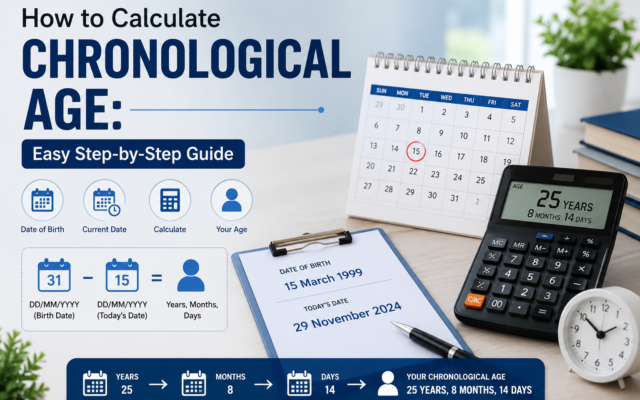
Chronological age is the most familiar kind of age there is. It’s the exact amount of time that has elapsed since your date of birth, measured up to a specific reference date — usually today.
How it’s calculated is straightforward: you take a birth date, compare it to a target date, and count the years, months, and days between them. There’s no biology involved, no lab work, no interpretation. It’s pure calendar math.
Date of birth is used as the anchor point because it’s a fixed, verifiable, and universally recognized marker. It doesn’t change, and it doesn’t depend on health status, ethnicity, lifestyle, or anything else. That’s precisely why chronological age is used on legal documents, medical intake forms, school enrollment records, insurance applications, and virtually every official context where a person’s age needs to be established without ambiguity.
A short example: if someone was born on March 3, 1990, and you want to know their chronological age on August 8, 2026, you’d count forward from the birth date to the reference date. That gives you a precise figure in years, months, and days — not an estimate, not a range, just a fact.
This is also why chronological age is objective and easy to calculate. Anyone with a birth date and a calendar can work it out by hand, and an online chronological age calculator can do the same thing instantly, factoring in leap years and varying month lengths so the result is accurate down to the day.
What chronological age cannot do is tell you anything about how someone’s body is actually functioning. It doesn’t account for fitness level, chronic disease, sleep quality, stress, or genetics. Two people can share an identical chronological age and have almost nothing else in common health-wise. That gap is exactly what the concept of biological age tries to address.
What Is Biological Age?
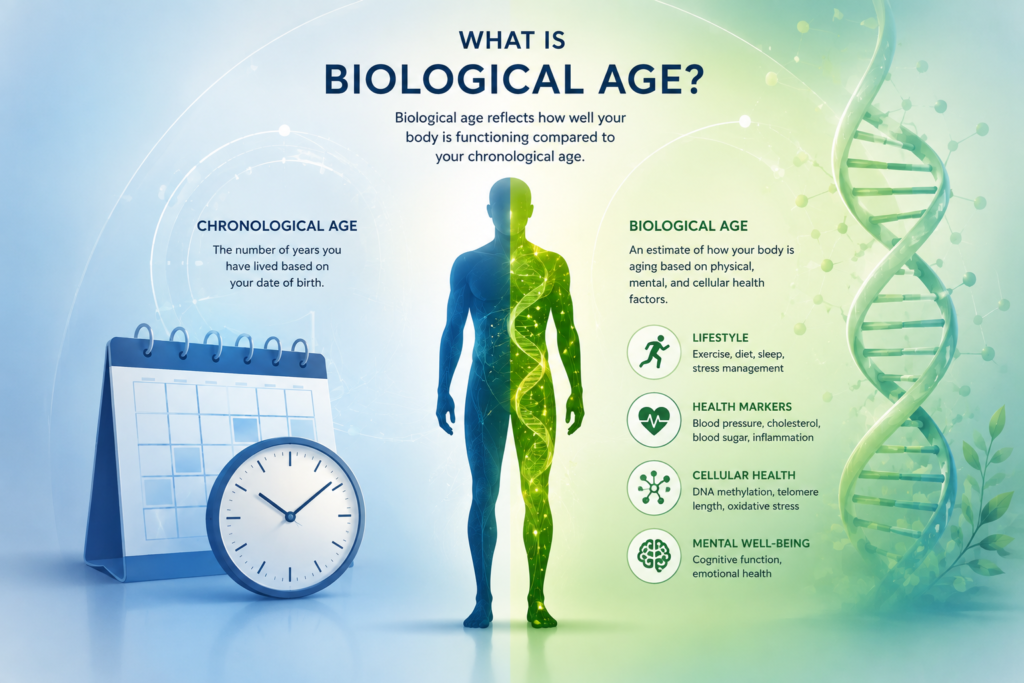
Biological age attempts to represent something chronological age was never designed to capture: how a person’s body is functioning at a physiological or molecular level, independent of how many years have technically passed since birth.
Where chronological age is a fact, biological age is an estimate — a model-based approximation built from measurable indicators like blood markers, physical performance, organ function, or molecular signals such as DNA methylation patterns. Researchers and test developers select a set of these indicators, compare them to patterns typically seen across a reference population at different ages, and use that comparison to generate a biological-age estimate.
This is why biological age can differ from chronological age, sometimes considerably. A person’s physiological condition — how well their cardiovascular system, metabolism, immune function, or cellular repair processes are working — doesn’t always track neatly with the number of birthdays they’ve had. Genetics, lifestyle, environment, and chronic health conditions all leave measurable traces on the body, and biological-age models try to read those traces.
It’s worth being clear that biological age is not simply a reflection of how young or old someone looks. Skin appearance, hair color, or wrinkles are influenced by many factors — including sun exposure and genetics — that don’t necessarily correlate with internal physiological aging. Biological age, as researchers use the term, is concerned with function and biomarkers, not appearance.
Because biological age is an estimate rather than a fixed fact, different tests and different methodologies can produce different results for the same person. A blood-biomarker-based estimate and a DNA-methylation-based estimate might not agree, because they’re measuring different biological signals through different statistical models. This doesn’t necessarily mean one is “wrong” — it means biological age is a family of related concepts and measurement approaches, not a single universal number.
Chronological Age vs Biological Age: Key Differences
| Aspect | Chronological Age | Biological Age |
|---|---|---|
| Definition | Time elapsed since birth | Estimate of physiological or molecular aging |
| Based on | Date of birth and reference date | Biomarkers, physiological data, or molecular signals |
| Calculation | Simple date arithmetic | Statistical or algorithmic modeling |
| Main purpose | Legal, administrative, developmental tracking | Health insight and research into aging processes |
| Changes over time | Increases at a fixed, predictable rate | Can fluctuate depending on health and lifestyle changes |
| Influenced by lifestyle? | No | Yes, potentially |
| Influenced by genetics? | No | Yes, potentially |
| Precision | Exact and objective | Estimated, with some variability between methods |
| Common examples | Birth certificates, ID documents | Blood panels, epigenetic clocks, fitness assessments |
| Can it differ between people of the same chronological age? | No — it’s identical by definition | Yes — often significantly |
The table highlights something important: chronological age is a single, universally agreed-upon fact, while biological age is more like a category of related tools that each try to answer a similar question in different ways.
Chronological age changes at a completely fixed rate — one year for every year that passes, with no exceptions. Biological age, by contrast, is sensitive to what’s happening inside the body. It can theoretically shift in either direction as health, habits, and physiological markers change, though how much it can shift, and how reliably, depends heavily on the specific measurement method being used.
Because chronological age is deterministic, it’s also comparable across contexts in a way biological age isn’t. Two clinicians using the same birth date will always agree on someone’s chronological age. Two labs using different biological-age algorithms may not agree on someone’s biological age at all — which is an important limitation to keep in mind.
Can Your Biological Age Be Different From Your Chronological Age?
Yes — this is essentially the entire premise behind biological-age research. It’s entirely possible for a biological-age estimate to come out higher or lower than someone’s chronological age, and this is one of the most common findings researchers point to when explaining why the concept is useful.
Consider a simple hypothetical: two people are both 40 years old chronologically. One has spent years prioritizing regular movement, consistent sleep, and a varied diet, and has biomarkers that are associated with healthier aging patterns for their age group. The other has dealt with chronic stress, disrupted sleep, and a sedentary routine, and has biomarkers more commonly associated with faster biological aging. A biological-age test might estimate the first person’s biological age as somewhat younger than 40, and the second person’s as somewhat older — even though both are exactly 40 years old chronologically.
It’s important to underline that these estimates depend heavily on the method used. A biological age calculated from a blood-based panel might not match one calculated from an epigenetic clock, because they’re built on different assumptions and different underlying data. Neither should be treated as an absolute, unquestionable number — think of them as informative estimates rather than verdicts.
Why Do Chronological Age and Biological Age Differ?
Several overlapping factors contribute to the gap between the two.
Genetics
Inherited characteristics play a role in how a person’s body tends to age, including susceptibility to certain conditions, metabolic tendencies, and cellular repair efficiency. Genetics is one piece of a much larger picture, though — it doesn’t determine someone’s aging trajectory on its own, and it interacts constantly with lifestyle and environment.
Physical Activity
Regular physical activity is consistently associated with better cardiovascular health, stronger muscles, improved mobility, and markers linked to healthier aging overall. Activity supports circulation, helps maintain bone density, and contributes to metabolic and cognitive health as people get older.
Nutrition
A dietary pattern that includes a variety of fruits, vegetables, adequate fiber, sufficient protein, and general moderation is associated with better long-term health outcomes. No single “anti-aging diet” has been proven to reverse biological aging, and readers should be cautious of any claim that suggests otherwise — but overall dietary quality is one of the more consistently studied lifestyle factors linked to healthy aging.
Sleep
Sufficient, consistent sleep supports recovery, hormonal regulation, immune function, and cognitive performance. Chronic sleep disruption is associated with a range of negative health outcomes, which is part of why sleep quality is often included in discussions of biological aging.
Chronic Stress
Long-term, unmanaged stress can affect cardiovascular health, immune response, and mental well-being over time. Because of this, stress management — through routine, social support, physical activity, or other coping strategies — is frequently discussed as relevant to healthy aging.
Smoking and Alcohol
Smoking is strongly associated with a wide range of negative health outcomes, and excessive alcohol consumption is linked to increased risk for several chronic conditions. Both are commonly factored into discussions of biological aging because of their well-documented effects on the body over time.
Chronic Health Conditions
Long-term conditions such as metabolic disorders or cardiovascular disease can influence the biomarkers used in biological-age estimates. This doesn’t mean having a chronic condition automatically defines someone’s biological age, but it can be one contributing factor among many.
Environmental Factors
Broader factors — including air quality, occupational exposures, socioeconomic circumstances, and access to healthcare — may also play a role in physiological health over time. These factors are complex and interconnected, and while research continues to explore their relationship to aging, they shouldn’t be reduced to simple cause-and-effect claims.
How Is Biological Age Measured?
There is no single, universally accepted way to measure biological age. Instead, researchers and test developers use several different approaches, each with its own strengths and limitations.
Biomarker-based methods combine multiple measurable health indicators — such as blood pressure, cholesterol levels, or blood glucose — into a composite score that’s compared against typical patterns for different age groups.
Blood-based measurements look at specific markers in the blood, such as inflammatory markers or metabolic indicators, that tend to shift in predictable ways as people age.
Physiological measurements may include things like lung function, grip strength, or balance, which often decline in fairly predictable patterns over time and can be used to estimate physiological age.
Fitness and functional measurements assess how well the body performs physically — cardiovascular endurance, mobility, and muscular strength are common examples.
Epigenetic clocks use patterns of DNA methylation (explained more below) to generate an age estimate based on molecular changes rather than physical performance.
Composite biological-age algorithms combine several of the above categories into a single statistical model, weighting different inputs based on how strongly they correlate with age in research populations.
It’s worth repeating clearly: no commercial biological-age test currently provides a definitive, guaranteed prediction of how long someone will live. These tools offer estimates based on correlations observed in study populations, and different tests can — and often do — produce different biological-age numbers for the same person, simply because they’re built on different markers and different underlying algorithms.
What Is an Epigenetic Age?
Epigenetic age is a specific type of biological-age estimate based on DNA methylation — a chemical process where small molecular tags attach to DNA and can influence how genes are expressed, without changing the underlying genetic code itself.
As people age, patterns of DNA methylation tend to shift in ways that are statistically predictable across large populations. Researchers have built mathematical models — often called “epigenetic clocks” — that use these methylation patterns to generate an age estimate. This estimate is sometimes referred to as epigenetic age.
It’s helpful to keep three related but distinct terms separate:
- Chronological age — the exact time since birth.
- Biological age — a broader category of estimates based on various physiological or molecular indicators.
- Epigenetic age — a specific type of biological-age estimate based specifically on DNA methylation patterns.
Epigenetic clocks are an active area of scientific research, and while they’ve become one of the more widely discussed biological-age methods, they remain estimates derived from population-level statistical models, not a direct readout of a person’s remaining lifespan or a diagnostic tool.
What Is the Difference Between Biological Age and Physiological Age?
These two terms are sometimes used interchangeably, but depending on the context, they can refer to somewhat different concepts.
“Physiological age” is often used to describe how well specific body systems — cardiovascular, respiratory, musculoskeletal — are functioning relative to typical age-related benchmarks. It tends to focus on functional performance: how efficiently your organs and systems are working.
“Biological age,” as a broader term, can incorporate physiological function but often extends further, including molecular and cellular markers like those used in epigenetic clocks or blood-based biomarker panels.
There isn’t one universal definition used consistently by every researcher or organization, which is part of why the terminology in this space can feel inconsistent. When reading about biological age or physiological age, it’s worth paying attention to exactly which markers and methodology a given source is using, since that context shapes what the resulting number actually means.
Can You Calculate Chronological Age More Accurately Than Biological Age?
Yes, and this is one of the clearest distinctions between the two concepts. Chronological age can be calculated with complete precision because it’s based on two fixed data points: a date of birth and a reference date. There’s no modeling, no estimation, and no variability — the math either is or isn’t correct.
Biological age, by contrast, is generally estimated using measurements, biomarkers, and statistical models, which inherently involve some degree of approximation and can vary depending on the method used.
Here’s a practical example. Suppose someone was born on January 15, 1986, and we want their chronological age as of August 8, 2026. Counting forward from the birth date to the reference date gives an exact result: 40 years, 6 months, and 24 days. That figure isn’t an estimate — it’s a direct calculation, and it will be identical no matter who performs it or which tool they use, as long as the same two dates are used.
This is where a chronological age calculator is genuinely useful: it performs this exact-day arithmetic instantly and avoids the small counting errors that can creep in when someone does the math manually, especially around leap years or month-length differences.
Can You Lower Your Biological Age?
This is a question that deserves a careful, honest answer rather than a marketing-style promise.
You cannot change your date of birth, and you cannot make your chronological age move backward — that part is fixed and always will be. What’s genuinely being discussed when people talk about “lowering biological age” is whether certain biomarkers or estimates, generated by a specific test, can shift in a favorable direction based on changes in health and lifestyle.
Some research suggests that certain biological-age measures may change over time in response to factors like improved fitness, better sleep, or other health changes. However, it’s important to understand the limitations here: an improvement in one health marker does not guarantee that every biological-age test will show a younger result, because different tests weigh different inputs. Biological-age estimates also should not be treated as a guaranteed measure of how long someone will live — they’re a snapshot based on a particular methodology, not a verified prediction of lifespan.
With that caution in mind, several evidence-associated healthy behaviors are commonly discussed in the context of supporting healthier aging generally:
- Regular physical activity, including both cardiovascular and strength-based exercise
- Consistent, adequate sleep
- A varied, balanced diet
- Stress management practices
- Avoiding tobacco use
- Responsible, moderate alcohol consumption
- Maintaining regular preventive healthcare and checkups
- Maintaining social connections and a sense of community
These habits are associated with better overall health outcomes in general. They are not presented here as a way to “reverse aging,” and no one should interpret them as a guaranteed method to lower a specific biological-age test result.
This article is for general educational purposes and is not a substitute for professional medical advice, diagnosis, or treatment.
Lifestyle Factors That May Support Healthier Biological Aging
| Lifestyle Factor | Why It Matters for Healthy Aging | Practical Example |
|---|---|---|
| Exercise | Supports cardiovascular health, mobility, and metabolic function | A brisk 30-minute walk most days of the week |
| Strength training | Helps preserve muscle mass and bone density over time | Two to three resistance sessions per week |
| Sleep | Supports recovery, hormone regulation, and cognitive health | Aiming for consistent, adequate nightly sleep |
| Balanced nutrition | Provides nutrients associated with better long-term health | A plate with vegetables, protein, and whole grains |
| Stress management | May reduce the physiological toll of chronic stress | Regular downtime, mindfulness, or hobbies |
| Avoiding smoking | Reduces exposure to substances linked with accelerated health decline | Seeking support to quit if currently smoking |
| Maintaining social connections | Associated with better mental and physical health outcomes | Regular contact with friends, family, or community groups |
| Preventive healthcare | Helps catch and manage health issues early | Routine checkups and recommended screenings |
Chronological Age vs Biological Age Example
The following examples are illustrative only and are not medical assessments or diagnoses.
Example 1: Two 30-year-olds with different lifestyles. Person A exercises regularly, sleeps consistently, and eats a varied diet. Person B works long, irregular hours, sleeps inconsistently, and has limited time for physical activity. Both are chronologically 30. A biological-age model might associate Person A’s markers with a younger estimate and Person B’s with an older one — though again, this depends entirely on which markers and method are used.
Example 2: Two 50-year-olds with different fitness levels. Person C has maintained regular strength and cardiovascular training for years and has strong functional fitness markers. Person D has a more sedentary routine and lower cardiovascular fitness. Functional and fitness-based biological-age assessments might reflect this difference, even though both are chronologically 50.
Example 3: A biological age estimate older than chronological age. Person E is chronologically 45 but has several biomarkers — for instance, related to metabolic health — that are more commonly seen in older individuals within a reference population. A composite biological-age algorithm might therefore estimate their biological age as somewhat higher than 45. This is a hypothetical scenario meant to illustrate the concept, not a diagnostic outcome.
Is Biological Age More Important Than Chronological Age?
Neither should automatically be treated as “more important” — they serve different purposes.
Chronological age remains essential for legal, demographic, developmental, and many medical contexts. It determines eligibility for things like voting, driving, retirement benefits, and specific medical screening guidelines, and it plays a role in tracking developmental milestones in children.
Biological-age concepts, on the other hand, can offer additional insight into physiological health that chronological age alone doesn’t capture. They can be a useful complement to traditional health metrics, prompting conversations about lifestyle and prevention.
That said, a biological-age number — from any test — should never replace a professional medical assessment. It’s a supplementary data point, not a diagnostic tool, and shouldn’t be the sole basis for major health decisions.
Does a Younger Biological Age Mean You Are Healthier?
Not necessarily, and this is a nuance worth sitting with rather than glossing over.
Different biological-age tests measure different things, using different biomarkers and different statistical models. A result from one test isn’t automatically comparable to a result from another, and a “younger” score on one test doesn’t guarantee a similarly favorable score on a different test.
Health itself is multidimensional. Fitness, blood pressure, metabolic health, mental well-being, mobility, and disease risk all matter, and none of them can be fully captured by a single number. A biological-age estimate might reflect some of these dimensions well and others poorly, depending on which markers it’s built from. Treating a single biological-age result as a complete verdict on someone’s health oversimplifies something genuinely complex.
What Is a Good Biological Age?
There’s no universal “perfect” biological-age number, and any source that offers one specific target for everyone should be viewed with some skepticism.
A biological-age result should always be interpreted in context, including:
- The specific test or method used
- The person’s chronological age
- Sex, where relevant to the particular test
- Overall health status
- Which biomarkers were included
- The reference population the test was built on
- The underlying methodology and how it was validated
Because these variables differ so much between tests, a “good” result on one test isn’t necessarily comparable to a “good” result on another. Rather than chasing a specific number, it’s generally more useful to think of biological-age estimates as one input among many when considering overall health trends over time.
How Accurate Are Biological Age Tests?
Accuracy varies significantly depending on the test.
Different biological-age tests use different methodologies, which means results can vary from one test to another, sometimes substantially, even for the same person. Some methods are primarily research-oriented and have been studied extensively in academic settings. Others are commercial products that may use proprietary formulas not fully disclosed to the public, which makes independent verification more difficult.
A single biological-age result should not be treated as a medical diagnosis. It’s a statistical estimate, and like most estimates, it carries some degree of uncertainty. Repeated measurements — even using the same test — may still show some variation depending on factors like the specific sample collected, timing, and testing conditions.
Understanding the difference between a useful health metric and a definitive medical diagnosis matters here. A biological-age result can be an interesting, potentially motivating data point. It is not equivalent to a lab-confirmed diagnosis from a physician, and it shouldn’t be treated as one.
Chronological Age Calculator vs Biological Age Calculator
These two types of calculators serve fundamentally different purposes and require very different inputs.
A chronological age calculator generally requires just two pieces of information: a date of birth and a calculation or reference date. From there, the math is deterministic — the same inputs will always produce the same output.
A biological-age calculator or test, by contrast, typically requires health information such as biomarkers, laboratory measurements, fitness data, or other physiological information. The output depends on which specific method or algorithm the calculator uses, meaning the same person could get different results from different biological-age tools.
In short, chronological age calculation is straightforward and deterministic, while biological age is usually an estimate based on a selected methodology — and that distinction is worth keeping in mind whenever comparing results from different sources.
How to Calculate Your Chronological Age
If you want to work out your own chronological age by hand, the process is simple:
- Record your date of birth. This is your fixed starting point.
- Choose the date on which you want to calculate your age. This is often today’s date, but it can be any reference date.
- Compare the year, month, and day between the two dates.
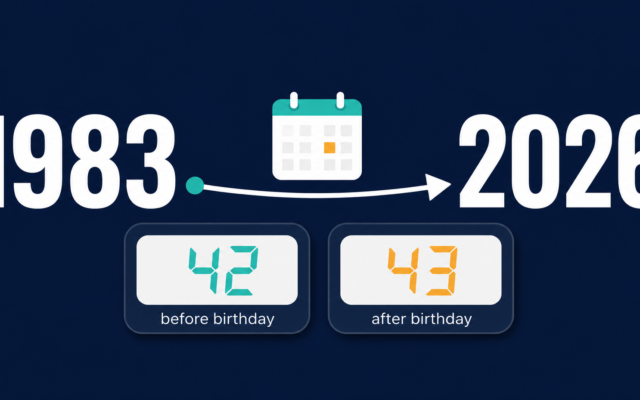
- Adjust for whether your birthday has occurred yet in the current year — if it hasn’t, subtract one year from your initial year-count and adjust the months and days accordingly.
- Express the result in years, months, and days, if you want a precise breakdown rather than just a whole number.
When working with two dates like this, a Date Difference Calculator can help determine the exact amount of time between them, which is useful well beyond birthday calculations — for tracking anniversaries, project timelines, or any other date-based interval. And if you’re curious about the midpoint between birthdays specifically, the same date-based logic applies to a Half-Birthday Calculator, which some people use for tracking half-year milestones. Naturally, an online chronological age calculator can also handle this entire process automatically, instantly returning an exact age in years, months, and days without any manual counting.
It’s worth noting that this kind of precise date arithmetic is a completely different category of tool from something like a share incentive plan calculator, which deals with financial vesting schedules and equity value rather than personal age — the two simply happen to both involve dates and numbers.
Conclusion
Chronological age and biological age answer two different questions. Chronological age tells you exactly how much time has passed since birth — it’s fixed, objective, and identical for anyone sharing the same birth date and reference date. Biological age attempts to describe something more complex: how a person’s body is functioning at a physiological or molecular level, based on biomarkers, physical measurements, or molecular signals like DNA methylation.
The comparison of chronological age vs biological age matters because these two numbers can diverge, sometimes considerably, and that divergence is influenced by genetics, physical activity, nutrition, sleep, stress, and other lifestyle and environmental factors. But it’s worth remembering that biological age is always an estimate, shaped heavily by the specific method used to calculate it — different tests can and do produce different results for the same person.
Healthy habits, including regular physical activity, balanced nutrition, adequate sleep, and stress management, are associated with markers linked to healthier aging in general, even though no test can guarantee a specific biological-age outcome or reliably predict lifespan. Ultimately, neither chronological age nor biological age should be interpreted in isolation. Together, they offer a more complete — though still imperfect — picture of how a person is aging over time.
Frequently Asked Questions About Chronological Age vs Biological Age
1. What is the difference between chronological age and biological age? Chronological age is the exact time elapsed since birth, calculated from a birth date and a reference date. Biological age is an estimate of how a person’s body is functioning physiologically or molecularly, based on biomarkers, physical measurements, or molecular signals like DNA methylation. When comparing chronological age vs biological age, the key distinction is that one is a fixed fact and the other is a modeled estimate.
2. Can biological age be younger than chronological age? Yes. Some biological-age estimates can come out lower than a person’s chronological age, particularly when biomarkers associated with healthier aging patterns are present. This is a hypothetical possibility supported by the general concept behind biological-age testing, not a guarantee for any individual.
3. Can biological age be older than chronological age? Yes, similarly, biological-age estimates can come out higher than chronological age if measured biomarkers align with patterns more commonly seen in older individuals within a reference population.
4. How is chronological age calculated? It’s calculated by comparing a date of birth to a reference date and counting the years, months, and days between them. It’s a precise, objective calculation with no estimation involved.
5. How is biological age measured? There are several approaches, including biomarker panels, blood-based measurements, physiological and fitness assessments, and epigenetic clocks based on DNA methylation. Different methods can produce different biological-age estimates for the same person.
6. Is biological age scientifically accurate? Biological-age methods are grounded in ongoing scientific research, but accuracy varies by method, and no test provides a perfectly precise or universally validated number. Results should be viewed as estimates rather than definitive facts.
7. What is epigenetic age? Epigenetic age is a type of biological-age estimate based on patterns of DNA methylation, a molecular process that can be statistically associated with age. It’s one specific approach within the broader category of biological-age measurement.
8. Can lifestyle affect biological age? Lifestyle factors such as physical activity, sleep, nutrition, and stress management are associated with certain biomarkers used in biological-age estimates. Research suggests lifestyle may influence some biological-age measures, though results vary by method and individual.
9. Can exercise make your biological age younger? Regular exercise is associated with markers linked to healthier aging, and some research suggests it may be associated with more favorable biological-age estimates on certain tests. It should not be treated as a guaranteed way to lower every biological-age test result.
10. Is chronological age more reliable than biological age? In terms of precision, yes — chronological age is exact, while biological age is an estimate with inherent variability. However, “reliable” depends on the purpose: chronological age is reliable for legal and administrative use, while biological age can offer additional health-related insight despite its estimated nature.
11. Is a biological-age test a medical diagnosis? No. Biological-age tests provide estimates based on selected biomarkers and statistical models. They are not diagnostic tools and should not replace assessment by a qualified healthcare professional.
12. Can two people with the same chronological age have different biological ages? Yes, this is one of the central ideas behind the concept. Two people with an identical chronological age can have very different biological-age estimates depending on their genetics, lifestyle, health conditions, and the specific biomarkers being measured.