How to Calculate Chronological Age: Easy Step-by-Step Guide
Most people think they already know their age. You count the years since you were born, and that’s that. But if you’ve ever needed to fill out a medical form, register a child for kindergarten, or apply for a pension, you’ve probably run into the more precise term: chronological age. It sounds clinical, but it’s really just your exact age, calculated down to the year, month, and day.
Knowing how to calculate chronological age matters more than most people realize. Schools use it to decide which grade a child belongs in. Doctors use it to track growth and development. Employers and government agencies use it to determine eligibility for retirement benefits, licenses, and legal rights. Even psychologists rely on it when comparing a person’s mental or developmental age to their actual age in years.
In this guide, you’ll learn exactly how to calculate chronological age by hand, using a simple formula, and with the help of an online chronological age calculator. We’ll walk through real examples, explain the tricky parts like leap years and month adjustments, compare chronological age to biological, mental, and developmental age, and answer the most common questions people have about this topic. By the end, you’ll be able to calculate anyone’s exact age with confidence, whether you’re doing it manually or reaching for a free chronological age calculator to save time.
How to Calculate Chronological Age
What Is Chronological Age?
Chronological age is the exact amount of time that has passed since a person was born, measured in years, months, and days. It’s the number you’d write on a form when asked “how old are you,” calculated precisely rather than rounded to the nearest birthday.
This might seem obvious, but the precision matters in certain fields. A teacher deciding whether a child is old enough for first grade doesn’t just want to know “she’s six.” They need to know she turned six on a specific date, because school cutoff dates are often exact. A pediatrician plotting a baby’s growth chart needs the child’s age in weeks or months, not a rounded estimate.
Chronological age is different from other types of “age” you might hear about, such as biological age (how old your body seems based on health markers) or mental age (a measure used in some psychological assessments). We’ll get into those comparisons later. For now, just remember this: chronological age is purely a measure of time, calculated from your birth date to today’s date, or to any other reference date you choose.
Why Chronological Age Matters
You might wonder why anyone needs a formal process for something as simple as counting years. The truth is, once you factor in months, days, and leap years, the math gets more complicated than it first appears. And in several real-world situations, getting it exactly right isn’t optional.
Here’s where chronological age plays a genuinely important role:
- Education. School enrollment often depends on a strict age cutoff, sometimes down to the day.
- Healthcare. Vaccination schedules, growth percentiles, and developmental screenings are all tied to precise age in months or years.
- Legal matters. Voting eligibility, the legal drinking age, and contract capacity all hinge on chronological age.
- Employment and retirement. Pension eligibility and mandatory retirement ages are calculated using exact birth dates.
- Psychological and developmental assessments. Chronological age is the baseline against which mental age and developmental age are compared.
Because so much depends on getting this number right, it’s worth understanding how the calculation actually works instead of just eyeballing it.
How to Calculate Chronological Age Step by Step
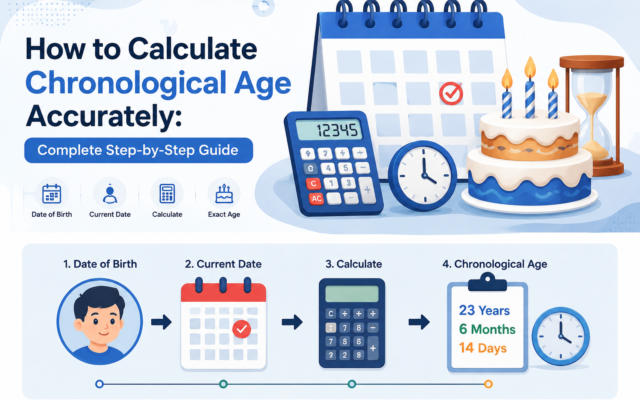
Calculating chronological age isn’t hard once you break it into pieces. The core idea is simple: subtract the birth date from the current date. But because our calendar doesn’t divide evenly into 12 equal months, you need a few adjustment steps to get an accurate result.
Birth Date
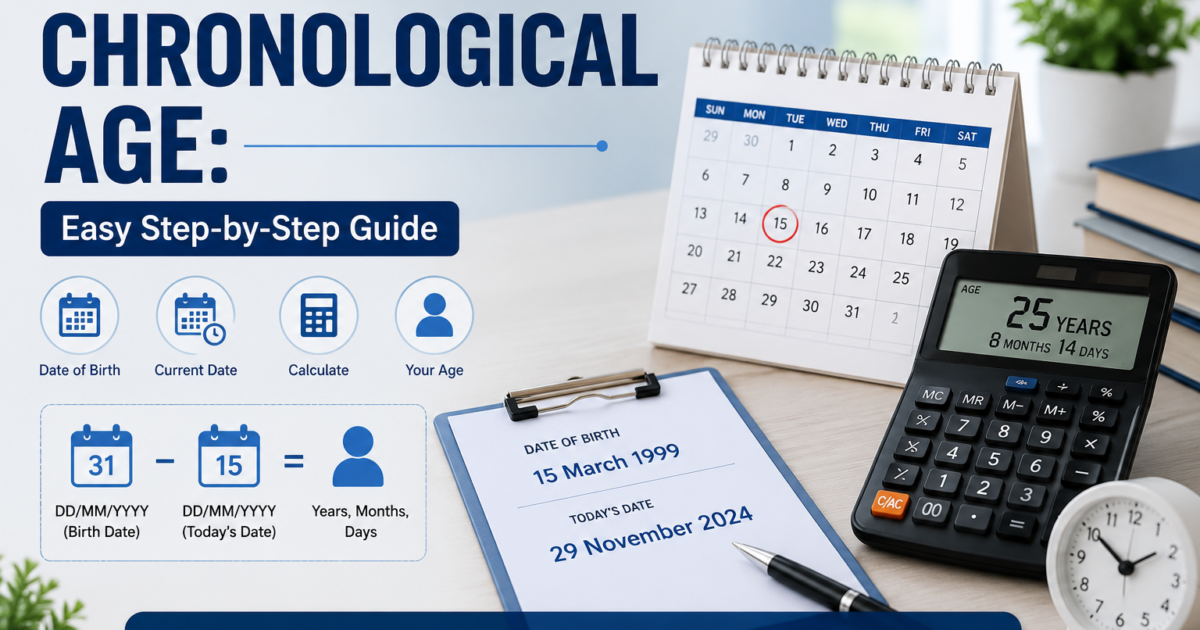
Start by writing down the exact birth date in day, month, year format. This is your fixed starting point, and every other calculation is measured against it.
Current Date
Next, identify the date you want to calculate the age as of. Most often this is today’s date, but it could be any reference date, such as the first day of a school term or the date of a medical appointment.
Year Calculation
Subtract the birth year from the current year. This gives you a rough age, but it’s not final yet. If the birth month and day haven’t happened yet this year, you’ll need to subtract one from this number.
Month Adjustment
Compare the current month to the birth month. If the current month is earlier in the calendar than the birth month, that means the birthday hasn’t occurred yet this year, so you subtract a year from your total and adjust the month count accordingly.
Day Adjustment
If the current day of the month is earlier than the birth day, borrow a month, similar to how you’d borrow in subtraction with regular numbers. This ensures the day count doesn’t come out negative.
Leap Years
Leap years add an extra day to February every four years (with some exceptions for century years not divisible by 400). This mostly affects people born on February 29, since their “actual” birthday only occurs once every four years. In non-leap years, most systems treat their birthday as either February 28 or March 1, depending on local convention.
Time Zones
Time zones rarely affect chronological age calculations in daily life, but they can matter in edge cases, such as babies born close to midnight during international travel, or legal disputes involving exact birth times across time zones. For nearly all practical purposes, using the calendar date recorded on the birth certificate is sufficient.
Common Mistakes
People often round age up or down without meaning to, forget to adjust for the month and day, or miscount leap years. We’ll cover a full list of these mistakes later in the article, along with how to avoid them.
Example 1
Let’s say someone was born on March 15, 1990, and you want to calculate their age as of July 19, 2026.
- Start with the year difference: 2026 minus 1990 equals 36.
- Check the month: July (7) comes after March (3), so the birthday has already happened this year.
- Check the day: the 19th is after the 15th, so no adjustment is needed.
Result: 36 years old.
Example 2
Now consider someone born on October 8, 1995, calculated as of July 19, 2026.
- Year difference: 2026 minus 1995 equals 31.
- Check the month: July (7) comes before October (10), meaning the birthday hasn’t happened yet this year.
- Subtract one year: 31 minus 1 equals 30.
Result: 30 years old.
Example 3
This time, let’s calculate age in years, months, and days for someone born on February 20, 2000, as of July 19, 2026.
- Year difference: 2026 minus 2000 equals 26.
- Month difference: July (7) minus February (2) equals 5 months.
- Day difference: the 19th minus the 20th is negative, so borrow one month. That leaves 4 months, and you add the number of days in June (30) to the day count: 19 plus 30 minus 20 equals 29 days.
Result: 26 years, 4 months, and 29 days old.
Formula for Calculating Chronological Age
Here’s the calculation laid out in a clean, reusable format:
Years = Current Year − Birth Year

If (Current Month < Birth Month) OR
   (Current Month = Birth Month AND Current Day < Birth Day):
      Years = Years − 1

Months = Current Month − Birth Month
If Months is negative, add 12 and subtract 1 from Years

Days = Current Day − Birth Day
If Days is negative, borrow a month:
   Days = Days + (number of days in the previous month)
   Months = Months − 1
This is essentially the same logic that runs behind the scenes of any age chronological calculator you’ll find online. Once you understand it, you can do it manually with a calendar and a pen, though most people prefer to skip straight to a digital tool for speed and accuracy.
Manual Calculation vs Online Chronological Age Calculator
Doing the math yourself is a great way to understand the concept, but it’s not always the most practical option, especially when you’re calculating ages for multiple people or need results instantly.
| Factor | Manual Calculation | Online Chronological Age Calculator |
|---|---|---|
| Speed | Slower, requires careful subtraction | Instant results |
| Accuracy | Prone to human error with leap years and month borrowing | Consistently accurate |
| Convenience | Needs a calendar and some math | Just enter a birth date |
| Best for | Learning the concept, one-off checks | Repeated use, forms, professional settings |
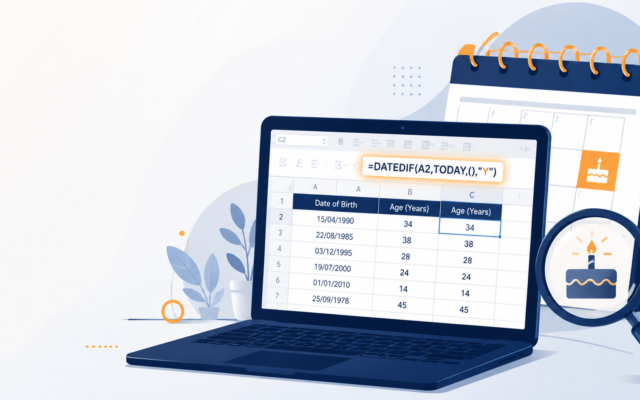
| Bulk calculations | Impractical | Easy, especially with spreadsheet tools |
An online chronological age calculator handles all the tricky adjustments automatically. You type in a birth date, and it instantly returns your age in years, months, and days. This is especially useful for parents tracking a baby’s developmental milestones week by week, or HR professionals verifying eligibility for retirement plans.
That said, understanding the manual method is still valuable. It helps you double-check a calculator’s output, spot errors, and explain the result to someone else without just pointing at a screen.
Benefits of Using a Free Chronological Age Calculator
There’s a reason so many people skip the manual math and go straight to a tool. A free chronological age calculator offers a few clear advantages:
- Instant results. No need to count months on your fingers or double-check leap years.
- Zero cost. Most reputable calculators are free to use, with no signup required.
- Reduced errors. The tool handles date-borrowing logic automatically, which is where most manual mistakes happen.
- Accessibility. Available on any device with a browser, making it useful for teachers, nurses, HR staff, and parents alike.
- Precision on demand. You can calculate age as of any date, not just today, which is useful for retroactive eligibility checks or historical research.
Because these tools are free and widely available, there’s rarely a good reason to rely purely on manual math when accuracy really counts, such as for medical or legal documentation.
Age Chronological Calculator Explained
An age chronological calculator works by taking two dates, a birth date and a reference date, and applying the same year, month, and day adjustment logic described earlier in this guide. Behind the scenes, most calculators convert both dates into a standard numerical format, then run subtraction operations that account for varying month lengths and leap years automatically.
Some calculators go a step further and offer extra features, such as:
- Calculating age in total days or weeks, useful for infant care and pediatric milestones.
- Showing the exact time until your next birthday.
- Comparing chronological age against biological or developmental benchmarks.
- Displaying results in multiple formats (years only, years and months, or full breakdown).
The appeal of these tools is that they remove the guesswork. You don’t need to remember whether February has 28 or 29 days this year, or whether you should round up or down. You just enter the birth date, and the calculator does the rest.
Chronological Age vs Biological Age
Chronological age and biological age sound similar, but they measure very different things.
| Aspect | Chronological Age | Biological Age |
|---|---|---|
| Definition | Time since birth, based on the calendar | Estimated age of your body based on health markers |
| How it’s measured | Simple date subtraction | Blood tests, cellular markers, lifestyle factors |
| Can it change unexpectedly | No, it only moves forward at a fixed rate | Yes, it can be higher or lower than chronological age |
| Influenced by | Nothing, it’s purely mathematical | Diet, exercise, sleep, stress, genetics |
| Common use | Legal, educational, administrative purposes | Health and longevity research |
In short, your chronological age always matches the calendar. Your biological age is an estimate of how well your body has held up, and it can be younger or older than your actual years depending on lifestyle and genetics. The World Health Organization frames healthy aging around maintaining functional ability and wellbeing rather than a fixed number of years, which is part of why researchers treat biological age as a separate measure from the simple calendar-based number.
Chronological Age vs Mental Age
Mental age is a concept most often used in psychology and cognitive assessments, particularly with children.
| Aspect | Chronological Age | Mental Age |
|---|---|---|
| Definition | Actual time since birth | Cognitive ability level compared to typical age norms |
| How it’s measured | Date calculation | Standardized cognitive or intelligence tests |
| Purpose | Administrative, legal, medical | Psychological and educational assessment |
| Can it be higher or lower | No, always accurate to birth date | Yes, can be above or below chronological age |
| Example use | School enrollment | Identifying learning differences or giftedness |
A child with a chronological age of eight might have a mental age of ten if they perform above average on cognitive assessments, or a mental age of six if they’re developing more slowly in certain areas. Neither number replaces the other. Chronological age tells you how old someone is. Mental age tells you how their cognitive development compares to that age group.
Chronological Age vs Developmental Age
Developmental age is closely related to mental age but tends to focus more broadly on physical, social, and emotional milestones rather than purely cognitive testing.
Chronological age stays fixed to the calendar no matter what. Developmental age, on the other hand, reflects where a person actually stands in terms of physical growth, motor skills, language, and social behavior compared to typical benchmarks for their age group. Pediatricians and early childhood specialists often use developmental age alongside chronological age to spot delays or advances early, which allows for timely intervention when needed.
For example, a toddler with a chronological age of two might be evaluated as having a developmental age closer to eighteen months in terms of speech, which could prompt a referral for speech therapy. This distinction is one of the reasons chronological age remains such an important baseline measurement across healthcare and education.
How Schools and Doctors Use Chronological Age
Educational institutions rely heavily on chronological age for enrollment decisions. Most school districts set a specific cutoff date, and a child’s exact birth date determines whether they qualify for a particular grade level that year. Missing the cutoff by even a single day can mean waiting an entire year to enroll.
In healthcare, chronological age is the backbone of nearly every pediatric assessment. Growth charts plot a child’s height and weight against their exact age in months. Vaccination schedules are timed to specific ages, often down to the week for infants. Developmental screening tools compare a child’s current abilities to what’s typical for their exact chronological age, which helps doctors catch potential delays early.
CDC growth charts, used by pediatricians and parents since 1977, are built from percentile curves that track a child’s measurements against their exact age, and that process depends entirely on accurate chronological age at each visit. Psychologists and educational specialists also use chronological age as the reference point when calculating mental age or developmental age, since without an accurate baseline, those comparisons wouldn’t mean anything.
How Employers and Government Agencies Use Chronological Age
Outside of schools and doctor’s offices, chronological age plays a major role in employment and government systems.
- Retirement eligibility. Pension systems and Social Security benefits are calculated based on exact birth dates, often down to the month.
- Licensing. Driving licenses, professional certifications, and certain permits have minimum age requirements tied to chronological age.
- Legal rights. Voting age, the legal age to purchase alcohol or tobacco, and the age of majority all depend on exact chronological age.
- Employment law. Some jobs have minimum or maximum age requirements, particularly in physically demanding fields or roles involving public safety.
- Immigration and identification. Passports, visas, and identity verification processes rely on chronological age calculated from official birth records.
Because these systems often involve legal consequences, the calculations need to be precise. A single day’s error in chronological age could affect someone’s eligibility for a benefit or their ability to legally perform certain activities.
Can You Calculate Your Lunar Age?
If you’ve spent time researching age calculation, you may have come across the term “lunar age,” particularly in the context of East Asian age-counting traditions. Unlike chronological age, which is based on the solar (Gregorian) calendar and calculated from your exact birth date, lunar age follows a different set of rules rooted in the lunar calendar.
In traditional systems used historically in countries like Korea and China, a person is considered one year old at birth, and everyone’s age increases by one year on the lunar new year, regardless of their actual birth date. This means two people born just a few months apart could have very different lunar ages compared to their chronological ages.
If you want to calculate your lunar age, you generally need to know your birth date according to the lunar calendar, not just the standard Gregorian calendar, and then count how many lunar new years have passed since your birth. Because the lunar calendar doesn’t align neatly with the solar calendar, this typically requires either a specialized calculator or a lunar-to-solar date conversion chart.
It’s worth noting that lunar age is a cultural and traditional measurement, not a scientific or legal one. For medical, educational, or legal purposes, chronological age based on the standard calendar remains the accepted standard almost everywhere in the world.
Common Mistakes When Calculating Age
Even a straightforward calculation like this trips people up more often than you’d expect. Here are the most common mistakes:
- Forgetting to adjust for the month. Simply subtracting birth year from current year without checking whether the birthday has occurred yet.
- Ignoring the day of the month. Two people born in the same month can have different current ages depending on whether their exact day has passed.
- Miscounting leap years. Especially tricky for anyone born on February 29.
- Rounding age incorrectly. Rounding up before a birthday has actually occurred.
- Using inconsistent date formats. Mixing up day/month/year with month/day/year formats leads to wildly incorrect results.
- Forgetting time zones in edge cases. Rare, but relevant for births near midnight during international travel.
- Confusing chronological age with age at last birthday versus nearest birthday. These aren’t always the same number.
- Manually borrowing months incorrectly. Getting the number of days in the “borrowed” month wrong.
- Using outdated calculators. Some free tools online have bugs around century leap years (like the year 2000 versus 1900).
- Assuming an approximate age is good enough. In legal, medical, or educational settings, “close enough” isn’t acceptable.
Avoiding these mistakes is much easier when you either follow the step-by-step formula carefully or use a reliable calculator.
Tips for Accurate Age Calculation
- Always double-check the birth date format before entering it into any tool.
- When doing manual math, write out the year, month, and day separately instead of trying to do it all in your head.
- Use a reliable, well-reviewed online chronological age calculator for anything official, like medical forms or legal documents.
- If you’re calculating age for someone born on February 29, decide in advance whether you’ll use February 28 or March 1 in non-leap years, and stay consistent.
- For professional or medical use, calculate age in days or weeks when precision really matters, especially for infants.
- Keep a record of the reference date you used for the calculation, in case you need to explain or verify the result later.
Conclusion
Learning how to calculate chronological age isn’t just a fun math exercise. It’s a skill that touches education, healthcare, employment, and legal systems in ways most people don’t think about until they need it. Whether you’re figuring it out by hand using the year, month, and day adjustment method, or reaching for an online chronological age calculator to get an instant, accurate answer, the underlying goal is the same: knowing exactly how much time has passed since someone’s birth.
We’ve covered the step-by-step formula, worked through several examples, compared chronological age to biological, mental, and developmental age, and even looked at how to calculate your lunar age if you’re curious about that tradition. We’ve also walked through common mistakes and practical tips to help you avoid them.
If you want quick, accurate results without doing the math yourself, using a free online tool is the simplest path forward. It takes the guesswork out of the equation and gives you a reliable number every time, whether you’re filling out a form, tracking a child’s development, or just satisfying your own curiosity.
Frequently Asked Questions
1. How do you calculate chronological age? To calculate chronological age, subtract the birth year from the current year, then adjust for the month and day if the birthday hasn’t occurred yet this year. This gives you an exact age in years, and you can extend the process to include months and days for more precision.
2. What is the difference between chronological age and biological age? Chronological age is a fixed number based purely on the calendar and your birth date. Biological age is an estimate of how old your body appears based on health markers, lifestyle, and genetics, and it can be higher or lower than your chronological age.
3. Can I calculate chronological age online? Yes, there are many free online tools designed specifically for this. You simply enter a birth date, and the calculator instantly returns your exact age in years, months, and sometimes days or weeks.
4. Are free chronological age calculators accurate? Reputable free chronological age calculators are generally very accurate, since they follow the same year, month, and day adjustment logic used in manual calculations, including proper handling of leap years.
5. Why do schools use chronological age instead of grade level alone? Schools use chronological age because enrollment cutoffs are often based on a specific date. A child’s exact age determines eligibility for a grade, sometimes down to a single day.
6. Does chronological age change based on time zones? In almost all everyday situations, no. Time zones only become relevant in rare edge cases, such as a birth occurring very close to midnight during international travel.
7. What is lunar age, and is it the same as chronological age? Lunar age is a traditional measurement used in some East Asian cultures, where age increases by one year at the lunar new year rather than on an individual’s birth date. It’s different from chronological age and isn’t used for legal or medical purposes.
8. How is chronological age used in psychology? In psychology, chronological age serves as the baseline for comparing mental age and developmental age, helping professionals identify whether someone’s cognitive or developmental progress aligns with, exceeds, or lags behind typical expectations for their age.
9. What happens if someone is born on February 29? People born on February 29 typically have their birthday recognized on either February 28 or March 1 during non-leap years, depending on local convention or personal preference, though their chronological age calculation still counts each full year normally.
10. Why is chronological age important for retirement and government benefits? Government agencies use chronological age to determine eligibility for programs like retirement benefits, often requiring an exact birth date to calculate when someone qualifies, sometimes to the month.
11. Can chronological age be calculated as of a date other than today? Yes. Chronological age can be calculated relative to any reference date, not just the current date, which is useful for retroactive eligibility checks, historical research, or scheduling future milestones.