How to Calculate Chronological Age Accurately: Complete Step-by-Step Guide
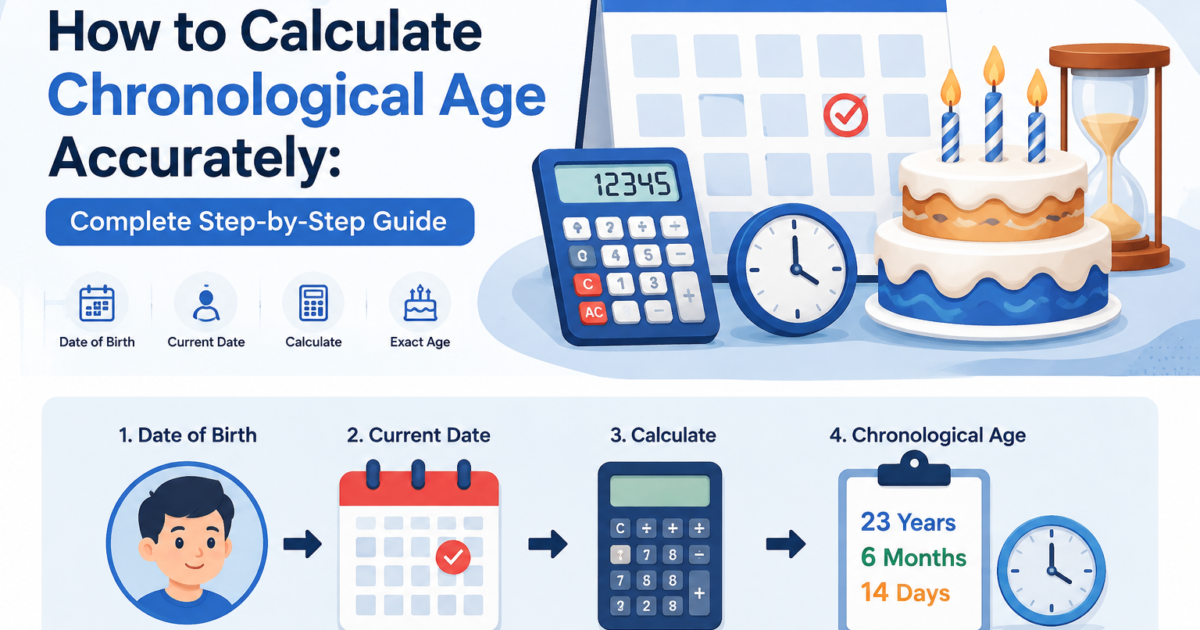
If you’ve ever needed to know someone’s exact age — not just the number they mention at a birthday party, but the precise years, months, and days since they were born — you already know it’s trickier than it sounds. That’s why so many parents, teachers, clinicians, and HR professionals search for a reliable way to calculate chronological age instead of doing rough mental math.
Chronological age is simply the amount of time that has passed since a person’s date of birth, measured up to a specific reference date. It sounds straightforward, but once you factor in different month lengths, leap years, and the need to “borrow” days and months during subtraction, manual calculations get messy fast — and small errors can matter a lot in clinical, educational, or legal settings.
In this guide, you’ll learn exactly how to calculate chronological age by hand, the logic behind the chronological age formula, the most common mistakes people make, and why so many professionals now prefer a free Chronological Age Calculator instead of doing it manually. Whether you’re a speech-language pathologist prepping for a Pearson assessment, a teacher checking school enrollment cutoffs, or a parent just curious about your child’s exact age, this article will walk you through everything step by step.
By the end, you’ll be able to calculate chronological age confidently — either with pen and paper, or in seconds using our online age calculator.
What Is Chronological Age?
Chronological age is the exact length of time a person has been alive, calculated from their date of birth to a chosen reference date — usually today’s date, but sometimes a past or future date, such as the day of a medical exam or a standardized test. It’s expressed in years, months, and days (and sometimes in weeks, hours, or minutes for more detailed clinical use).
Unlike a casual answer like “I’m 27,” chronological age is precise. It accounts for the exact number of completed years, plus the additional months and days beyond the most recent birthday. This precision is exactly why professionals rely on a dedicated age calculator online rather than rounding numbers in their head.
It’s worth clarifying how chronological age differs from a few terms people often confuse it with:
Chronological Age vs. Biological Age
Chronological age is a fixed, calendar-based number — it only depends on your birth date and today’s date. Biological age, on the other hand, is an estimate of how “old” your body appears to be based on health markers like cardiovascular fitness, cellular aging, and lifestyle factors. Two people with the same chronological age can have very different biological ages.
Chronological Age vs. Mental Age
Mental age refers to a person’s cognitive or intellectual functioning level compared to typical development for a given age group. It’s a concept used in some psychological and educational assessments, and it can be higher, lower, or equal to a person’s actual chronological age.
Chronological Age vs. Developmental Age
Developmental age reflects a child’s physical, emotional, social, or cognitive development relative to typical milestones — it’s commonly used in pediatrics and early childhood education. A premature infant, for example, may have a chronological age of six months but a developmental (or corrected) age closer to four months, based on how early they were born.
Understanding these distinctions matters because mixing them up can lead to real errors — especially in clinical and educational settings where accurate chronological age is a required input for other assessments.
Why Is It Important to Calculate Chronological Age?
Calculating chronological age accurately isn’t just a curiosity exercise — it has real, practical consequences across many fields.
Education. Teachers and school administrators use chronological age to determine grade placement, learning readiness, and eligibility for specific programs or accommodations.
School admissions. Most schools have strict enrollment cutoff dates. A child’s chronological age on a specific date — often down to the day — determines whether they qualify for kindergarten or a particular grade level that year.
Healthcare. Pediatricians and healthcare providers compare a child’s chronological age against growth charts and developmental milestones to catch potential delays early. Even a difference of a few weeks can shift where a child falls on a growth curve.
Child development. Occupational therapists and early intervention specialists use exact chronological age (sometimes adjusted for prematurity) to select age-appropriate developmental screening tools.
Psychology. Psychologists administering standardized tests — including many Pearson and Brigance assessments — must calculate the test-taker’s exact chronological age in years and months to correctly score results against normed data.
Employment. HR departments sometimes need to calculate chronological age for eligibility checks tied to labor laws, benefits enrollment, or retirement planning.
Legal documentation. Government agencies use exact date-of-birth calculations for identification, licensing, voting eligibility, and other official processes.
Sports eligibility. Youth sports leagues frequently set age-based divisions with specific cutoff dates, and a single day can determine which division a young athlete competes in.
Research. Academic and clinical researchers rely on precise chronological age data when analyzing cohorts, especially in longitudinal or developmental studies where age at testing is a key variable.
In every one of these situations, a rough estimate isn’t good enough. That’s why understanding how to calculate chronological age correctly — or using a tool that does it for you — genuinely matters.
How to Calculate Chronological Age
Now let’s get into the actual mechanics. If you’re wondering how to calculate chronological age manually, here’s the process broken into clear steps.
Step 1: Write Down the Birth Date
Start with the exact date of birth, in year-month-day format. For example: March 12, 2015.
Step 2: Write Down the Reference Date
This is the date you’re calculating the age as of — usually today, but it could be a test date, an application deadline, or any other relevant date. For example: April 22, 2026.
Step 3: Subtract the Years
Subtract the birth year from the reference year.
2026 − 2015 = 11 years (this is a starting point — it may need adjusting in the next steps)
Step 4: Subtract the Months
Subtract the birth month from the reference month.
April (4) − March (3) = 1 month
If this number is negative (meaning the reference month comes before the birth month in the calendar), you’ll need to borrow one year and add 12 to the month total. This is one of the most common places people make mistakes when they calculate chronological age by hand.
Step 5: Subtract the Days
Subtract the birth day from the reference day.
22 − 12 = 10 days
If this number is negative, borrow one month and add the number of days in the previous calendar month (which varies — this is where leap years come into play).
Step 6: Combine the Results
Putting it together: 11 years, 1 month, 10 days.
Worked Example
| Year | Month | Day | |
|---|---|---|---|
| Reference date | 2026 | 4 | 22 |
| Birth date | 2015 | 3 | 12 |
| Difference | 11 | 1 | 10 |
Result: 11 years, 1 month, 10 days — or 11;1 in clinical years;months notation, a format frequently required for standardized assessment scoring.
How Leap Years Affect the Calculation
Leap years add an extra day (February 29) roughly every four years. This matters most when your calculation involves borrowing days across a February in a leap year, since you’d borrow 29 days instead of the usual 28. Manually tracking every leap year across a multi-decade age calculation is exactly the kind of detail that trips people up — and exactly why an automated chronological age calculator is so useful for anyone doing this regularly.
A Trickier Example (With Borrowing)
Let’s calculate the age of someone born May 20, 2010, as of March 8, 2026.
- Years: 2026 − 2010 = 16
- Months: March (3) − May (5) = −2 → borrow 1 year, add 12 → 3 + 12 − 5 = 10 months, and reduce years to 15
- Days: 8 − 20 = −12 → borrow 1 month, add days from February 2026 (28 days, since 2026 is not a leap year) → 8 + 28 − 20 = 16 days, and reduce months to 9
Result: 15 years, 9 months, 16 days
This example shows exactly why manual age calculation gets complicated once borrowing is involved — and why double-checking with a calculate age by date of birth tool is worth the extra 10 seconds.
Chronological Age Formula
There isn’t a single universal mathematical formula that works identically for every calendar edge case — calendars are irregular by nature, with months of different lengths and leap years thrown in. But the general logic behind the chronological age formula can be summarized like this:
Chronological Age = Reference Date − Date of Birth, calculated field by field (years, then months, then days), with borrowing applied when a smaller unit would otherwise go negative.
Here’s the concept expressed more formally:
- Start with Years = Reference Year − Birth Year
- Start with Months = Reference Month − Birth Month
- Start with Days = Reference Day − Birth Day
- If Days < 0: borrow from Months (subtract 1 from Months, add the number of days in the prior month to Days)
- If Months < 0: borrow from Years (subtract 1 from Years, add 12 to Months)
This step-by-step, calendar-aware approach is what every reliable age calculation method — including automated tools — is ultimately built on.
More Worked Examples
Example 1 — Simple case (no borrowing needed): Birth date: January 10, 2000. Reference date: June 15, 2026. Years: 26, Months: 5, Days: 5 → 26 years, 5 months, 5 days
Example 2 — Day borrowing only: Birth date: July 25, 2018. Reference date: August 3, 2026. Days: 3 − 25 = negative → borrow from July (31 days): 3 + 31 − 25 = 9 days, Months reduce by 1 (0) Years: 8, Months: 0, Days: 9 → 8 years, 0 months, 9 days
Example 3 — Both month and day borrowing: Birth date: November 29, 2016. Reference date: January 5, 2026. Days: 5 − 29 = negative → borrow from December (31 days): 5 + 31 − 29 = 7 days, Months reduce by 1 Months: 1 − 11 = negative before borrowing days adjustment → borrow from Years: 12 + 1 − 11 = 2, minus the 1 already borrowed for days = 1 month Years: 9 Result: 9 years, 1 month, 7 days
These examples highlight why age calculation, while conceptually simple, requires careful attention to detail — exactly the kind of task that’s easy to automate and easy to get wrong by hand.
Common Mistakes When Calculating Age
Even careful people make errors when they calculate chronological age manually. Here are the most frequent ones:
Ignoring leap years. Forgetting that February has 29 days in a leap year throws off any calculation that borrows days across that month.
Wrong month calculations. Simply subtracting month numbers without checking whether borrowing is needed is one of the single biggest sources of error.
Incorrect borrowing of days. When borrowing a month, people often use a flat “30 days” assumption instead of checking the actual number of days in the specific month being borrowed from.
Confusing biological age with chronological age. As covered earlier, these are different concepts — using them interchangeably can lead to incorrect conclusions in health or fitness contexts.
Using the wrong reference date. Some calculations require age “as of” a specific test date or application deadline, not today’s date. Using the wrong reference point produces a technically accurate but practically useless number.
Rounding instead of calculating exactly. Saying someone is “about 7 and a half” isn’t the same as knowing they’re exactly 7 years, 5 months, and 18 days old — a distinction that matters in clinical and legal contexts.
Manual arithmetic errors under time pressure. Professionals calculating dozens of ages per day (teachers, clinicians, HR staff) are especially prone to small slip-ups that compound over repeated calculations.
Benefits of Using an Online Chronological Age Calculator
Given how many places manual calculation can go wrong, it’s no surprise that a free chronological age calculator has become the preferred method for most professionals and everyday users alike. Here’s why:
Accuracy. A well-built calculator automatically accounts for leap years, variable month lengths, and correct borrowing — eliminating the arithmetic mistakes covered above.
Speed. What takes several minutes of careful subtraction by hand takes about three seconds with an online age calculator.
Convenience. No need to remember the steps of the chronological age formula or double-check your own subtraction — just enter a date of birth and get the result instantly.
Mobile-friendly access. A good calculate current age tool works just as well on a phone in a waiting room as it does on a desktop in an office.
Instant calculations for multiple people. Tools with batch or comparison modes let teachers, clinicians, and HR professionals calculate age for several individuals at once, without repeating the manual process each time.
Reduced human error. This is the big one. In clinical and educational settings, an incorrect chronological age can lead to incorrect test scoring or misclassification — an automated tool removes that risk.
If you need age in years months and days for a report, form, or assessment, it’s worth using our free Chronological Age Calculator rather than working it out by hand. It’s built specifically for accuracy in professional contexts, including a clinical years;months notation toggle for psychologists and speech-language pathologists who need that exact format.
Real-Life Examples
Here’s how calculating chronological age plays out in a few everyday and professional scenarios.
Student. A school registrar needs to confirm whether a child born September 3, 2021, meets the September 1 kindergarten cutoff for the 2026–2027 school year. Calculating the child’s exact chronological age as of the cutoff date determines eligibility down to the day.
Employee. An HR coordinator is verifying an employee’s age for a benefits program with a minimum age requirement. Using an exact age calculator ensures the eligibility date is calculated correctly rather than estimated.
Medical patient. A pediatrician needs a patient’s precise chronological age in months to correctly interpret a growth chart during a well-child visit — a task where being off by even two or three weeks can shift the interpretation.
Passport application. A government office processing a passport renewal needs to confirm an applicant’s exact age on the application date to determine which document category and validity period applies.
Sports registration. A youth soccer league sets division cutoffs based on a player’s age as of a specific date each year. Calculating chronological age correctly determines which age bracket a child competes in for the season.
Research participant. A developmental psychology researcher collecting data on children needs each participant’s exact chronological age at the time of testing, since even small age differences can be statistically meaningful in developmental studies.
Across every one of these examples, the common thread is the same: precision matters, and a reliable calculate chronological age method — whether manual or automated — is essential to getting it right.
Frequently Asked Questions
1. What does chronological age mean? Chronological age is the exact amount of time that has passed since a person’s date of birth, measured up to a specific reference date, typically expressed in years, months, and days.
2. How do I calculate chronological age by hand? Subtract the birth date from the reference date field by field — years, then months, then days — borrowing from the next larger unit whenever a smaller unit would go negative.
3. What is the chronological age formula? There’s no single universal equation because calendars are irregular, but the general approach is: Reference Date − Birth Date, calculated year by year, month by month, and day by day, with borrowing applied as needed.
4. How is chronological age different from biological age? Chronological age is a fixed number based purely on the calendar. Biological age is an estimate of physical aging based on health and lifestyle factors, and it can differ significantly from chronological age.
5. Why do leap years matter in age calculations? Leap years add an extra day to February, which affects any calculation where days are borrowed across that month. Ignoring leap years is one of the most common sources of error in manual age calculations.
6. What is clinical chronological age? Clinical chronological age refers to a person’s exact age expressed in the years;months notation commonly required by standardized psychological and educational assessments, such as many Pearson and Brigance tests.
7. Can I calculate someone’s age as of a future or past date? Yes. Chronological age isn’t limited to “today” — you can calculate it as of any reference date, including a future test date or a past historical date, by using the same subtraction method.
8. What’s the difference between chronological age and corrected age? Corrected (or adjusted) age subtracts the number of weeks a baby was born premature from their chronological age. It’s used primarily for developmental screening in premature infants, typically until around age two.
9. Is an online age calculator more accurate than manual calculation? Generally, yes. A well-built chronological age calculator automatically handles leap years, variable month lengths, and correct borrowing, removing the arithmetic errors that commonly occur in manual calculations.
10. How do schools use chronological age for enrollment? Schools compare a child’s exact chronological age against an enrollment cutoff date to determine eligibility for kindergarten or a specific grade level for that academic year.
11. Why do psychologists need exact chronological age? Standardized assessments are normed against specific age brackets, so psychologists need a precise chronological age (often in years;months format) to select the correct norms and accurately score results.
12. What’s an easy way to calculate age difference between two people? An age difference calculator works the same way as a standard chronological age calculation, but instead of using today’s date as the reference point, it compares two individual birth dates directly.
13. Does chronological age include hours and minutes? Standard chronological age is expressed in years, months, and days, but some advanced calculators can also break the result down into total weeks, days, hours, and minutes for more detailed use cases.
14. Can I use a chronological age calculator for legal purposes? Online calculators are excellent for informational and professional-reference purposes, but for official legal documentation, it’s best to verify calculations against a birth certificate or government record.
15. Is my birth date information safe when I use an online calculator? A well-designed calculator performs all calculations directly in your browser without sending or storing your date of birth on a server, so your information stays private.
16. What is the fastest way to calculate current age? The fastest and most reliable way to calculate current age is to enter your date of birth into a free online age calculator, which returns your exact age in years, months, and days within seconds.
17. Why might two chronological age calculators give slightly different results? Small discrepancies can happen if calculators use different rounding rules or reference date handling. Using a consistent, well-tested tool for all your calculations helps avoid confusion.
Conclusion
Learning how to calculate chronological age — whether by hand or with a digital tool — comes down to one core idea: carefully subtracting a birth date from a reference date, field by field, while correctly handling borrowing across months and leap years. It’s a skill that matters far beyond curiosity, shaping decisions in classrooms, clinics, HR departments, courtrooms, and research labs alike.
While the manual method is useful to understand, it’s also easy to get wrong under time pressure or across large date ranges. That’s exactly why so many parents, teachers, healthcare professionals, and researchers now rely on a dedicated tool instead. Our free Chronological Age Calculator handles leap years, month-length differences, and clinical years;months notation automatically, so you can calculate chronological age accurately in seconds rather than minutes.
If you found this guide helpful, explore our Calculators hub for related tools, including our Birthday Calculator, or head back to the homepage to calculate your exact age right now.