How to Calculate Age From Date of Birth the Easy Way in (2026)

If you’ve ever tried to work out someone’s exact age by hand — counting on your fingers, flipping through a calendar, muttering “wait, has their birthday happened yet this year?” — you already know it’s easier than it sounds until it isn’t. The moment you need the answer in years, months, and days, or you’re calculating age as of a date that isn’t today, simple subtraction stops working the way you’d expect.
This guide walks through exactly how to calculate age from date of birth, step by step, with real examples, common mistakes, a few different methods depending on how precise you need to be, and answers to the questions people run into most often. Whether you’re filling out a form, checking eligibility for something age-restricted, or just curious how old you’ll be on a specific future date, you’ll have a clear, repeatable process by the end.
Why Calculating Age Isn’t Always as Simple as It Looks
At first glance, age calculation looks like basic subtraction: take the current year, subtract the birth year, done. That works fine if you only need a rough whole-number age and the birthday has already happened this year. But it breaks down in a few common situations:
- The birthday hasn’t happened yet this year, so simple year subtraction gives you a number that’s one too high.
- You need the age expressed in years, months, and days — not just a single number.
- You’re calculating age as of a date other than today (a policy start date, an eligibility cutoff, a historical date).
- Leap years and varying month lengths (28, 29, 30, or 31 days) throw off manual day-counting.
None of these are complicated once you know the method, but they’re exactly the kind of small details that lead to off-by-one errors when people do the math in their heads.
The Basic Formula how to calculate age from date of birth
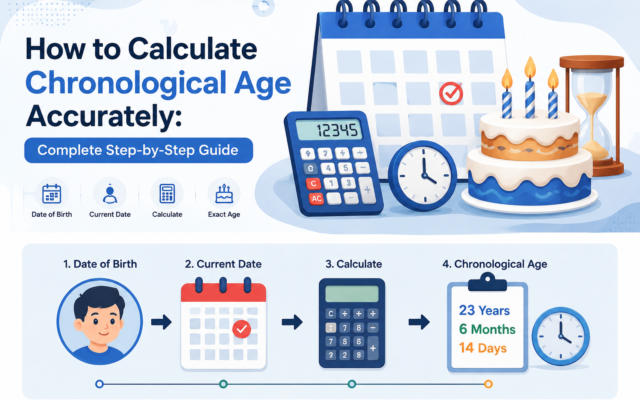
At its core, calculating age from date of birth involves comparing two dates: the date of birth and a reference date (usually today, but it could be any date you’re interested in).
Here’s the general logic:
- Subtract the birth year from the reference year to get a preliminary age.
- Check whether the birth month and day have already occurred in the reference year.
- If the birthday hasn’t happened yet as of the reference date, subtract 1 from the preliminary age.
- If you want a more precise breakdown, calculate the remaining months and days separately.
That fourth step is where most manual calculations go wrong, so let’s break it down properly.
Step-by-Step Method
Step 1: Write down both dates clearly. For example: Date of birth = March 22, 1994. Reference date = August 8, 2026.
Step 2: Subtract the years. 2026 − 1994 = 32.
Step 3: Check the month and day. Has March 22 already occurred by August 8 in 2026? Yes — March comes before August. So no adjustment is needed here, and the age remains 32.
Step 4: Calculate the remaining months and days, if needed. From March 22 to August 8 is 4 months and 17 days. So the exact age is 32 years, 4 months, and 17 days.
Now let’s look at a case where the birthday hasn’t happened yet.
Example: Date of birth = November 10, 1994. Reference date = August 8, 2026.
- 2026 − 1994 = 32 (preliminary).
- Has November 10 occurred by August 8 in 2026? No — November comes after August.
- So subtract 1: the age is actually 31, not 32.
- To find the months and days: count backward from August 8, 2026 to November 10, 2025 (the most recent birthday that has occurred). That gives 8 months and 29 days.
- Final result: 31 years, 8 months, and 29 days.
This is the single most common source of manual calculation errors — forgetting to check whether the birthday has already occurred before finalizing the year count.
A Quick Reference Table
| Scenario | Rule |
|---|---|
| Birth month/day has already occurred this year | Age = reference year − birth year |
| Birth month/day has NOT occurred yet this year | Age = (reference year − birth year) − 1 |
| Birthday is exactly today | Age = reference year − birth year (birthday just occurred) |
| Born in a leap year (Feb 29) | Age typically counted from Feb 28 or Mar 1 in non-leap years, depending on jurisdiction |
| Calculating exact months/days | Count forward from the most recent birthday to the reference date |
Why Leap Years Complicate Things
Leap years add an extra day (February 29) roughly every four years to keep the calendar aligned with Earth’s orbit. This creates two minor complications:
- People born on February 29 don’t have a literal birthday in most years. Conventions vary — some treat their birthday as February 28, others as March 1, in non-leap years. Legal definitions can differ by country, so if this applies to you and the exact date matters for something official (like eligibility for a benefit), it’s worth checking local rules.
- Day-counting across leap years requires knowing whether February has 28 or 29 days in the specific year you’re calculating through. If you’re counting days manually across a leap year without accounting for this, you can end up off by a day.
This is one of the areas where doing the math by hand becomes genuinely error-prone, and it’s part of why a dedicated tool is often more reliable than manual counting.
How an Online Age Calculator Simplifies This
A Chronological Age Calculator automates the entire process described above. You enter a date of birth and, optionally, a reference date (if you want your age as of a date other than today), and it instantly returns your exact age in years, months, and days — correctly accounting for leap years, varying month lengths, and whether the birthday has occurred yet.
This is particularly useful in situations like:
- Filling out forms that require your exact age, not just your birth year
- Checking age eligibility for school enrollment, sports leagues, or age-restricted services
- Calculating someone’s age as of a specific historical or future date
- Settling a friendly debate about exactly how many days old someone is
- HR or administrative work where precise age verification matters
Rather than manually counting months and days — and risking a small arithmetic slip — a chronological age calculator gives you an instant, accurate answer with essentially zero chance of error, similar to how a Starbucks Calorie Counter takes the guesswork out of adding up nutrition numbers instead of trying to estimate them yourself.
Calculating Age in Different Units
Depending on what you need the age for, you might want it expressed differently:
In Years Only
This is the most common format, used for most everyday purposes — filling out forms, general conversation, age-based eligibility checks.
In Years, Months, and Days
This is useful when precision matters — for example, pediatric growth tracking, certain legal or medical contexts, or simply wanting an exact figure rather than a rounded one.
In Total Days
Some people like to know their exact age in total days lived, which can be a fun way to mark milestones (turning 10,000 days old, for instance). This requires counting every day between the birth date and reference date, accounting for every leap year in between — a calculation that’s tedious by hand but instant with a calculator.
In Total Weeks or Months
Less common, but sometimes used in specific contexts like infant development tracking (age in weeks is often used for newborns) or general curiosity.
| Format | Typical Use Case |
|---|---|
| Years only | General purposes, forms, casual conversation |
| Years, months, days | Precise records, certain legal/medical contexts |
| Total days | Milestone tracking, personal curiosity |
| Weeks (for infants) | Pediatric and developmental tracking |
Real-World Scenarios Where Exact Age Calculation Matters
Scenario 1: School enrollment cutoffs. Many schools have a specific age-by-date rule (for example, a child must turn 5 by September 1 to enroll in kindergarten that year). Parents calculating this need to know precisely whether their child’s birthday falls before or after the cutoff — a case where getting the date math exactly right actually matters.
Scenario 2: Age-restricted eligibility. Certain services, memberships, or legal rights depend on someone having reached a specific age by a specific date — not just “being 18ish.” Calculating age as of that exact eligibility date avoids errors.
Scenario 3: Historical or genealogical research. If you’re researching how old a historical figure or ancestor was at a particular event, you need to calculate their age as of a date that isn’t today — which is exactly the kind of reference-date flexibility a proper age calculator provides.
Scenario 4: Insurance and financial calculations. Some insurance premiums, retirement account rules, or benefit eligibility depend on precise age thresholds on specific dates, making accurate date-of-birth calculations genuinely consequential.
Scenario 5: Simple personal curiosity. Sometimes there’s no practical stakes at all — you just want to know exactly how many years, months, and days you’ve been alive, or how old you’ll be on a future date like a wedding or milestone birthday.
Common Mistakes People Make When Calculating Age Manually
- Forgetting to check whether the birthday has occurred yet before finalizing the year count (the single most frequent error).
- Miscounting days across months with different lengths (30 vs. 31 days, or February’s 28/29).
- Ignoring leap years entirely when counting total days or months precisely.
- Confusing “age turned” with “age as of today.” For example, someone “turning 30 this year” isn’t necessarily 30 yet if their birthday hasn’t happened.
- Rounding instead of calculating exactly, which can matter in contexts like eligibility cutoffs where a single day can change the outcome.
Age Calculation Across Different Contexts
Age isn’t always calculated the same way everywhere. A few notable variations worth knowing about:
- Most Western countries calculate age the way described in this guide — based on the actual elapsed time since birth.
- Some East Asian traditional systems historically counted age differently, sometimes considering a person to be 1 year old at birth and adding a year at each subsequent New Year rather than on their birth date. Modern legal and administrative systems in these countries generally use the standard international method today, but the traditional system is still culturally referenced in some contexts.
- Legal age of majority (the age at which someone is legally considered an adult) varies by country and sometimes by context within a country, even though the underlying age calculation method is the same.
This guide focuses on the standard, internationally recognized method of counting age based on elapsed calendar time, which is what nearly all official and administrative contexts use.
Tips for Getting Age Calculations Right Every Time
- Always double-check whether the birth month and day have occurred as of your reference date before finalizing a year count.
- When precision matters, calculate in years, months, and days rather than rounding to a whole number.
- Be mindful of leap years when counting exact day totals.
- If you’re calculating age as of a date other than today, write both dates down clearly before doing any math — it’s easy to lose track otherwise.
- For anything with real consequences (legal eligibility, financial calculations, medical records), use a reliable calculator rather than relying on manual arithmetic, simply to eliminate the risk of a small counting error.
Final Thoughts
Calculating age from a date of birth seems simple until you need precision — an exact figure in years, months, and days, or an age calculated as of a date that isn’t today. The core method isn’t complicated: compare the years, check whether the birthday has occurred, and adjust accordingly. But small details like leap years, month-length differences, and the “has the birthday happened yet” check are exactly where manual calculations tend to go wrong.
Whether you’re double-checking an eligibility cutoff, filling out an official form, satisfying genuine curiosity, or just want a fast, reliable answer, understanding the logic behind age calculation — and knowing when to let a calculator handle the details — makes the whole process a lot less error-prone.
Frequently Asked Questions
1. How do I calculate my exact age from my date of birth? Subtract your birth year from the current year, then check whether your birthday has occurred yet this year. If it has, that’s your age. If it hasn’t, subtract one more year. For a fully precise answer including months and days, count forward from your most recent birthday to today.
2. What is the easiest way to calculate age without doing manual math? The simplest approach is to use an online age calculator. Enter your date of birth, and it automatically returns your exact age in years, months, and days, accounting for leap years and varying month lengths without any manual counting.
3. How do you calculate age as of a specific future or past date, not today? The process is the same as calculating current age, except you use the specific date you’re interested in as the reference date instead of today. Compare it to the birth date using the same year/month/day logic described above.
4. Why does my calculated age sometimes seem off by one year? This almost always happens because the birthday hadn’t occurred yet as of the reference date, but the calculation only subtracted the birth year without checking the month and day. Always verify whether the birth month and day fall before or after the reference date.
5. How is age calculated for someone born on February 29? Since February 29 only exists in leap years, conventions vary for non-leap years — some treat the birthday as February 28, others as March 1. If the exact date matters for a legal or official purpose, it’s worth checking the specific rule that applies in your context.
6. Can I calculate my age in total days instead of years? Yes. This involves counting every calendar day between your birth date and the reference date, including adjustments for leap years. It’s tedious to do by hand accurately, which is where a calculator becomes especially useful.
7. Is there a difference between “age” and “age turned this year”? Yes. “Age turned this year” refers to the age someone will reach on their birthday within the current year, regardless of whether that birthday has happened yet. “Current age” refers to their actual age as of today, which depends on whether the birthday has already passed.
8. Do all countries calculate age the same way? Most countries today use the standard method based on elapsed time since birth, which is what this guide covers. A few cultures have historically used different traditional counting systems, though modern legal and administrative use is largely standardized internationally.