How to Calculate a Child’s Chronological Age (Step-by-Step Guide)
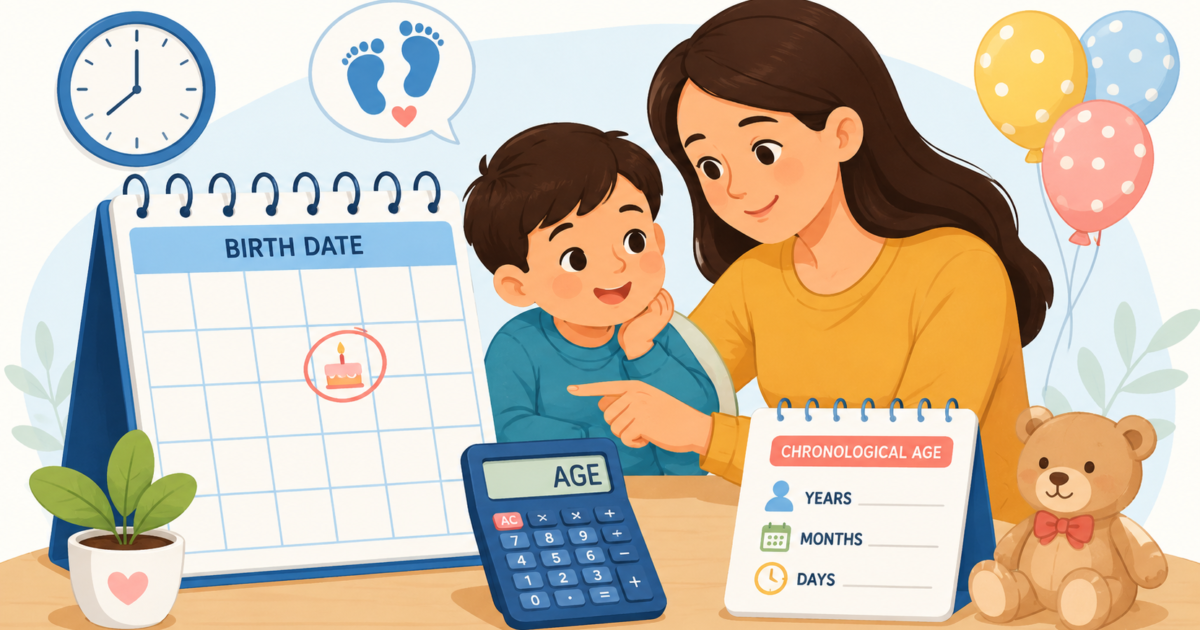
If you’ve ever filled out a school enrollment form, sat in a pediatrician’s waiting room, or reviewed the results of a developmental screening, you’ve probably run into the term “chronological age.” It sounds simple enough — it’s just how old a child is, right? Mostly, yes. But knowing how to calculate a child’s chronological age correctly, down to the exact year, month, and day, matters a lot more than most parents realize, especially when that number feeds into a test score, a school cutoff date, or a medical growth chart.
This guide walks through exactly what chronological age means, why professionals rely on it so heavily, and how to calculate it by hand using real, worked examples. Along the way, we’ll also touch on a few related ideas people often search for alongside it — mental age, lunar age, and how online age-difference calculators actually work — so you leave with the full picture, not just half of it.
What Is a Child’s Chronological Age?
Chronological age is simply the amount of time that has passed since a child’s date of birth, measured up to a specific reference date — usually today’s date, or whatever date an assessment, test, or medical exam took place. It’s expressed in years, months, and days, and it’s the most objective, universally agreed-upon way to describe how old someone is.
Here’s the part that trips people up: chronological age is not the same thing as developmental age or mental age.
- Chronological age is purely calendar-based. It doesn’t care how a child is doing in school, how tall they are, or how they’re progressing socially. It’s math, plain and simple.
- Developmental age describes where a child’s skills — motor, language, social, cognitive — actually fall compared to typical milestones for their age group. A child might be six years old chronologically but show developmental skills closer to a four- or five-year-old in certain areas.
- Mental age, a related but distinct concept, comes from psychological testing and reflects the age level at which a child is performing on cognitive tasks, regardless of their actual birth date.
Think of chronological age as the fixed anchor point. Everything else — developmental progress, test scores, growth percentiles — gets measured against that anchor. If the anchor is wrong, everything built on top of it shifts out of place too.
Why Is Chronological Age Important?
It’s easy to assume this is a minor administrative detail, but chronological age quietly shapes decisions across several major areas of a child’s life.
School admissions. Most school districts set a specific enrollment cutoff date. A child who misses that cutoff by even a day or two may need to wait an entire additional year before starting kindergarten or first grade.
Pediatric healthcare. Growth charts, vaccination schedules, and developmental screening tools are all built around precise age brackets. A doctor plotting a child’s height and weight percentile needs the exact chronological age — not a rounded estimate — to read the chart correctly.
Child development assessments. Standardized developmental checklists compare a child’s current skills to norms established for children of the exact same chronological age, often broken down into narrow bands like “24 to 27 months.”
Psychological evaluations. Many cognitive and psychoeducational assessments calculate a standard score by comparing a child’s raw test performance to their exact chronological age at the time of testing — not their age on their last birthday.
Educational testing. Standardized academic tests frequently adjust scoring based on a student’s precise age in years and months on the day of testing, which is why test administrators are trained to calculate this carefully rather than estimate it.
Government documentation. Passports, birth certificates, benefit eligibility, and legal age requirements all rely on exact date-of-birth calculations rather than approximate ages.
Sports eligibility. Youth sports leagues typically use strict age cutoff dates to determine which division a child plays in, and disputes over these cutoffs are common enough that many leagues require a certified birth certificate before registration.
In short, whenever a decision, score, or eligibility determination depends on “how old is this child, exactly,” someone somewhere is calculating chronological age — and getting it wrong can have real consequences.
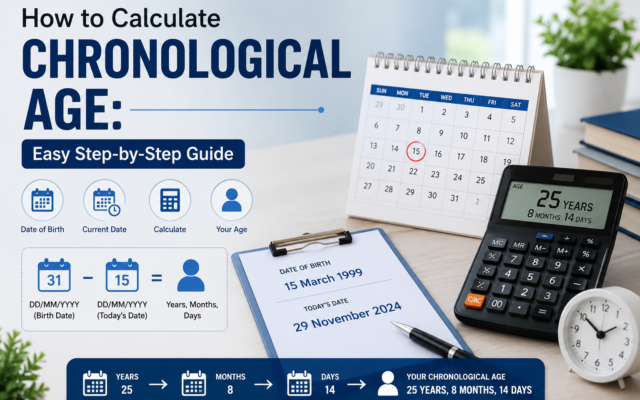
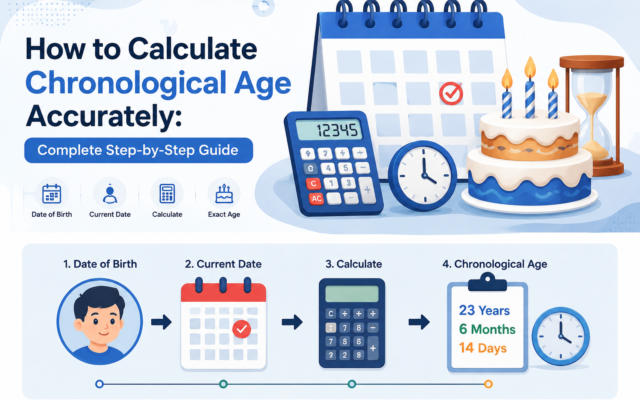
How to Calculate a Child’s Chronological Age (Step-by-Step)
The good news is that the math itself isn’t complicated. You just need two dates and a little patience with borrowing across months and years, the same way you’d borrow across columns in subtraction.
What you need:
- The child’s date of birth (day, month, year)
- The current date, or the specific assessment date if you’re calculating age as of a test, exam, or medical visit
- A way to subtract the two dates, working from days, to months, to years
The basic steps:
- Write both dates in the same format: year-month-day.
- Subtract the day of birth from the day of the assessment date.
- Subtract the month of birth from the month of the assessment date.
- Subtract the year of birth from the year of the assessment date.
- If the day or month subtraction results in a negative number, borrow from the next larger unit (a month becomes extra days, a year becomes extra months) — exactly like borrowing in a normal subtraction problem.
That last step is where most manual calculations go wrong, so let’s slow down and walk through it with real numbers.
Manual Calculation Example
Example 1: Straightforward Case
Date of birth: March 10, 2019 Assessment date: July 15, 2026
| Unit | Assessment Date | Date of Birth | Difference |
|---|---|---|---|
| Year | 2026 | 2019 | 7 |
| Month | 07 | 03 | 4 |
| Day | 15 | 10 | 5 |
No borrowing is needed here because the assessment day (15) and month (07) are both larger than the birth day (10) and month (03).
Chronological age: 7 years, 4 months, 5 days
Example 2: A Case That Requires Borrowing
Date of birth: August 22, 2020 Assessment date: March 3, 2026
Start with the raw subtraction:
- Day: 3 − 22 = negative, so we need to borrow.
- Borrow one month from March, turning it into February, and add the days in February (28, since 2026 is not a leap year) to the 3, giving us 31 days.
- Day: 31 − 22 = 9 days
- Month: now that we borrowed a month, the assessment month effectively becomes 2 (February). 2 − 8 = negative, so we borrow again.
- Borrow one year, turning it into 12 extra months. 2 + 12 = 14. 14 − 8 = 6 months
- Year: since we borrowed a year, 2026 becomes 2025. 2025 − 2020 = 5 years
Chronological age: 5 years, 6 months, 9 days
Example 3: Including a Leap Year
Date of birth: February 14, 2022 Assessment date: March 1, 2026
- Day: 1 − 14 = negative, so borrow a month. February 2026 has 28 days (2026 is not a leap year), so 28 + 1 = 29. 29 − 14 = 15 days
- Month: assessment month becomes 2 (February) after borrowing. 2 − 2 = 0 months
- Year: 2026 − 2022 = 4 years
Chronological age: 4 years, 0 months, 15 days
Notice how the leap year detail matters in the middle step — if you’d assumed February always has 30 days, or forgotten to check whether the borrowed month was a leap year, you’d end up with a slightly wrong final answer. That small error is common enough that it deserves its own section.
Using an Online Chronological Age Calculator
Doing this by hand is a great way to understand what’s actually happening behind the numbers, but it’s also easy to make a small subtraction mistake, especially when a birth date falls near the end of a month or during a leap year. That’s exactly the kind of detail an online age calculator handles automatically and instantly.
A good chronological age calculator asks for two things — a date of birth and an assessment date — and returns the result broken into years, months, and days without any manual borrowing required. Many tools, including the calculator available on this site, also let you enter a custom assessment date rather than defaulting to today, which is essential for psychologists, teachers, and clinicians who need to calculate a child’s age as of a specific test date that may have occurred weeks or months earlier.
If you regularly need this number for testing, screening, or record-keeping, using a calculator isn’t cutting corners — it’s simply removing an unnecessary source of human error from a calculation that other decisions depend on.
Common Mistakes People Make
Even people who are comfortable with basic math can trip over a few recurring pitfalls when calculating chronological age by hand.
- Ignoring leap years. February’s length changes depending on the year, and forgetting to check this when borrowing days can throw off the final day count.
- Incorrect month borrowing. Borrowing a month should add that month’s actual number of days (28, 29, 30, or 31) to the day column — not a flat 30, which is a shortcut that often produces the wrong answer.
- Using today’s date instead of the assessment date. This is one of the most common errors in clinical and educational settings. If a test was administered six weeks ago, the chronological age needs to be calculated as of that test date — not as of today, when someone happens to be scoring it.
- Wrong date format. Mixing up day/month/year and month/day/year formats (a common issue when working with international paperwork) can silently produce a completely wrong age without any obvious red flag.
- Rounding instead of calculating exactly. Saying a child is “about 5 and a half” might be fine for casual conversation, but standardized assessments typically require the age broken down to the exact month, and sometimes the exact day.
Chronological Age vs Mental Age
Chronological age and mental age sound similar, but they measure two entirely different things, and confusing them can lead to real misunderstandings about a child’s abilities.
Chronological age, as covered above, is strictly calendar-based. Mental age, on the other hand, comes out of cognitive testing and reflects the age level at which a child’s performance would be considered typical. If you’re wondering how to calculate mental age, the general concept (used historically in intelligence testing) involves comparing a child’s test performance to the average performance of children at various ages, then assigning the age level that best matches their results. In older intelligence quotient formulas, mental age was divided by chronological age and multiplied by 100 to produce a ratio IQ score — though modern psychological testing has largely moved toward more statistically robust methods that compare a child’s score to a large, age-matched norm group rather than relying on that simple ratio.
The key takeaway: a child’s mental age might be higher, lower, or equal to their chronological age, and neither one replaces the other. They’re used together, not interchangeably, and only trained professionals administering standardized tests should be calculating or interpreting mental age scores in any meaningful way.
Chronological Age vs Lunar Age
Here’s where things get culturally interesting. In several East Asian cultures, particularly in traditional Korean, Chinese, and Vietnamese age-counting customs, a person’s age has historically been calculated differently than the calendar-based system used in most of the world.
Under the traditional system often referred to as lunar age or “Korean age,” a baby is considered one year old at the moment of birth (accounting for time spent in the womb), and everyone gains an additional year on the first day of the new year, regardless of their actual birth date. This means someone born in late December could turn two years old just days after being born, simply because the calendar flipped to a new year.
If you’re trying to figure out how to calculate your lunar age, the traditional formula works out to roughly: current year minus birth year, plus one. So calculating your lunar age or calculating lunar age more generally comes down to that simple year-based offset — not the day-and-month precision used in chronological age.
It’s worth noting that South Korea officially discontinued this traditional age system in June 2023, formally adopting the international, birthday-based age system for legal, administrative, and most everyday purposes. The shift meant that, overnight, many South Koreans became one or two years “younger” on paper, even though nothing about their actual birth date had changed. Lunar age still holds cultural significance and shows up in certain traditions and casual conversation, but it should never be confused with chronological age, which remains strictly tied to the exact number of years, months, and days since birth.
Age Calculator Difference
You may also come across the phrase “age calculator difference” while searching for age-related tools, and it typically refers to calculators that compute the gap between two people’s ages, or the time span between two separate dates — rather than calculating one person’s age from a single birth date.
These difference calculators work on the same underlying date subtraction principle covered earlier in this guide, just applied to two full dates instead of one date and today’s date. For example, a parent might want to know the exact age gap between two siblings, or an adoption agency might need the precise difference between a child’s actual birth date and an estimated one. The calculator subtracts the earlier date from the later date, following the same year-month-day borrowing logic, and returns the difference in the same broken-down format.
Benefits of Using an Online Age Calculator
Manual calculation is a useful skill to understand, but for anyone doing this regularly — teachers, pediatric staff, school registrars, psychologists — an online calculator offers a handful of clear advantages.
- Accuracy. Removes the risk of manual subtraction and borrowing errors, especially around leap years and month-end dates.
- Speed. Produces an instant result instead of requiring several minutes of careful hand calculation per child.
- Leap year handling. Automatically accounts for February’s changing length without requiring the user to check a calendar.
- Medical use. Supports accurate growth chart plotting and vaccination scheduling, where even a few days’ difference can shift a child into a different percentile bracket.
- Educational use. Helps teachers and test administrators quickly calculate exact ages as of a specific testing date, rather than today’s date.
- Easy calculations for repeated use. Especially helpful for anyone processing multiple children’s ages in a single sitting, such as a classroom roster or a clinic’s daily patient list.
Conclusion
Learning how to calculate a child’s chronological age isn’t just an academic exercise — it’s a small but genuinely important skill that shows up in school registration lines, pediatrician’s offices, and psychological testing rooms far more often than most people expect. Whether you work through the subtraction by hand or lean on an online calculator to skip the borrowing and leap-year math, the goal is the same: an accurate, exact figure that other important decisions can safely be built on. If you find yourself needing this number often, keeping a reliable age calculator bookmarked can save you the trouble of double-checking your own subtraction every time a new birth date crosses your desk.
Frequently Asked Questions
What is a child’s chronological age? It’s the exact amount of time that has passed since a child’s date of birth, measured up to a specific reference date, and expressed in years, months, and days.
How do you calculate a child’s chronological age? Subtract the date of birth from the assessment date or today’s date, working through days, months, and years, and borrowing from the next larger unit whenever a subtraction results in a negative number.
Why is chronological age important? It’s used to determine school enrollment eligibility, interpret pediatric growth charts, score developmental and psychological assessments, and establish sports and legal age requirements, among other things.
Is chronological age different from developmental age? Yes. Chronological age is purely calendar-based, while developmental age reflects where a child’s actual skills fall compared to typical milestones, which can be ahead of, behind, or in line with their chronological age.
Can I calculate age without an online calculator? Absolutely — it just requires subtracting the birth date from the assessment date by hand, carefully borrowing days, months, or years as needed, as shown in the worked examples above.
How do leap years affect age calculations? Leap years change the number of days in February, which can affect the result when borrowing days during a manual calculation, particularly for birth dates or assessment dates that fall in or near February.
What is the difference between chronological age and mental age? Chronological age is based strictly on the calendar, while mental age is derived from cognitive testing and reflects the age level a child’s performance is most comparable to, regardless of their actual birth date.
What is lunar age? Lunar age, sometimes called Korean age, is a traditional East Asian age-counting method where a person is considered one year old at birth and gains a year on the first day of each new year, rather than on their actual birthday.
Are online age calculators accurate? Yes, a properly built age calculator accounts for varying month lengths and leap years automatically, making it typically more reliable than a rushed manual calculation.
Which assessment date should I use? Always use the actual date the test, exam, or medical evaluation took place — not the date you happen to be reviewing or scoring the results, since these can be weeks apart.