Chronological Age Calculator Speech: The Complete Guide to Understanding, Calculating, and Presenting Age Accurately

Time moves in one direction, whether we notice it or not. Every sunrise adds a tiny fraction to the number that defines how long we’ve been alive — our age. It sounds simple, but the moment you try to pin that number down to the exact year, month, and day, things get surprisingly detailed. That’s where the idea of a chronological age calculator speech comes in.
If you’ve ever been asked to explain, present, or teach how age is calculated — maybe for a school assignment, a classroom demonstration, or an educational seminar — you already know it’s not just about saying “I’m 20 years old.” A good speech on this topic digs into what chronological age really means, how a chronological age calculator works behind the scenes, and why getting this number right actually matters in real life.
In this guide, you’ll learn:
- What a chronological age calculator speech is and when people give one
- The real meaning of chronological age and how it compares to other types of age
- Step-by-step, how a chronological age calculator works
- A ready-made sample speech you can adapt for school or seminars
- Why these calculators matter in education, healthcare, fitness, and research
- How to calculate chronological age manually, without any tool
- The benefits of using an online chronological age calculator
- Common mistakes people make when calculating age
- Answers to the most frequently asked questions on this topic
Whether you’re a student prepping for a presentation, a teacher building a lesson plan, or simply someone curious about how these tools work, this article is written to give you everything you need in one place.
What Is a Chronological Age Calculator Speech?
Let’s start with the basics. Chronological age is simply the amount of time that has passed since a person was born, measured in years, months, and days, based on the calendar. It’s the number written on your ID card, the one you say out loud when someone asks “how old are you?”
A chronological age calculator speech, then, is a talk, presentation, or classroom demonstration that explains this concept — usually alongside an explanation of how a digital or manual calculator determines that age. It’s a topic that blends math, technology, and everyday relevance, which makes it a popular choice for:
- School presentations in math or computer science classes
- Educational seminars on data handling or basic programming logic
- Public speaking practice assignments where a “how something works” topic is required
- Workshops introducing beginners to simple formulas and logical thinking
- Parent-teacher demonstrations explaining developmental milestones tied to age
People choose this topic because it’s relatable — everyone has an age — but it also opens the door to explaining logic, subtraction across calendar units, and even basic programming concepts (since most digital calculators are just small programs performing date subtraction).
A well-structured chronological age calculator speech typically walks the audience through the definition of chronological age, explains the formula or logic used to calculate it, and often includes a live or example demonstration showing the calculation in action.
Understanding Chronological Age
To give a confident speech on this subject, you first need a rock-solid understanding of what chronological age actually means — and how it’s different from other “ages” people talk about.
What Chronological Age Means
Chronological age is purely calendar-based. It doesn’t care about how healthy you are, how you feel, or how you look. It only measures the exact time elapsed between your date of birth and a specific reference date — usually today’s date.
If someone was born on March 10, 2010, and today is August 7, 2026, their chronological age is the precise span between those two dates, expressed in years, months, and days.
Chronological Age vs. Other Types of Age
This is where the concept of chronological age vs biological age becomes important, and it’s a distinction worth including in any speech on the topic:
- Chronological age – the calendar-based measurement of time since birth
- Biological age – an estimate of how old your body appears to be based on health markers, cellular condition, and lifestyle factors; it can be higher or lower than chronological age
- Developmental age – used mostly in child psychology and education to describe a child’s stage of development compared to typical milestones for their chronological age
- Mental age – a psychological concept comparing cognitive ability to age-based norms
Real-Life Examples
- A doctor might say a 45-year-old patient has the “biological age” of a 35-year-old due to excellent fitness levels — but their chronological age is still 45.
- A school might use chronological age to determine which grade a child should enter, regardless of how advanced or behind they might be academically.
- Legal systems rely entirely on chronological age for things like voting rights, driving eligibility, and retirement benefits.
Understanding this distinction gives your speech more depth and shows the audience that chronological age, while simple in concept, has meaningful real-world applications.
How Does a Chronological Age Calculator Work?
Now let’s get into the mechanics — the part your audience will likely find most interesting, especially if you’re presenting to students or beginners.
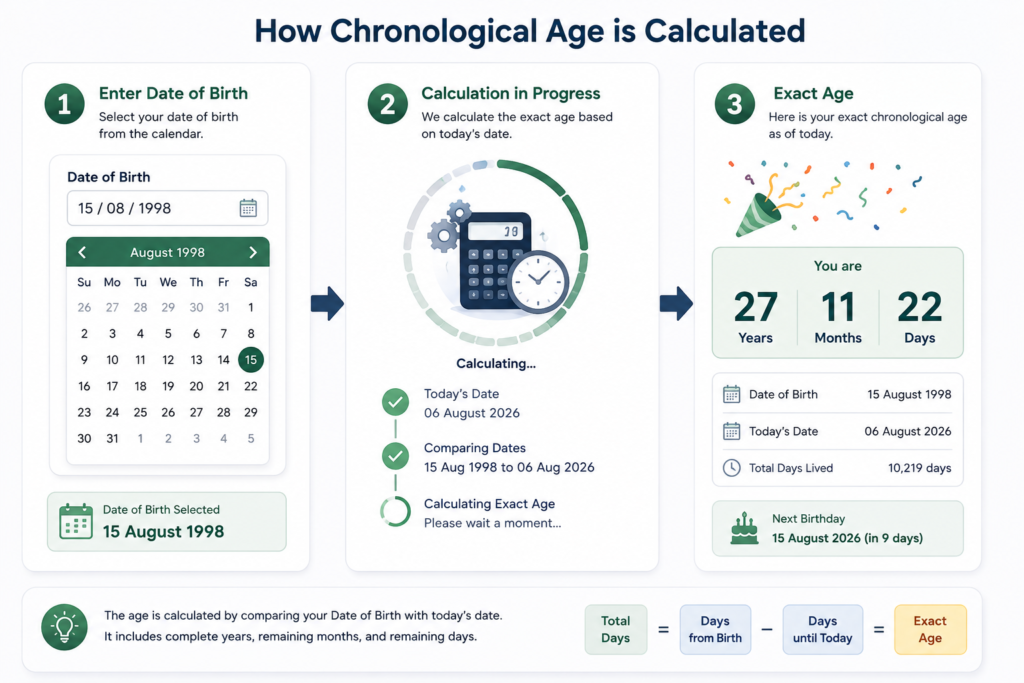
A chronological age calculator, whether it’s a website, an app, or a simple spreadsheet formula, follows a consistent logical process:
Step 1: Input Date of Birth
The user enters their date of birth (day, month, year). This becomes the starting point of the calculation.
Step 2: Select the Calculation Date
Most calculators default to today’s date, but many also let you pick a custom date — useful for calculating someone’s age as of a future event, like a graduation day or an exam eligibility cutoff.
Step 3: Calculate the Difference Between the Two Dates
This is the core logic. The calculator subtracts the date of birth from the calculation date, breaking the result into years, months, and days.
Step 4: Display Years, Months, and Days
The final output is shown in a clean, readable format — for example: “16 years, 4 months, 28 days.”
The Chronological Age Formula
Here’s the basic formula used behind the scenes:
Chronological Age = Calculation Date − Date of Birth
Broken down into components:
- Years = Calculation Year − Birth Year (adjusted if the birth month/day hasn’t occurred yet this year)
- Months = Calculation Month − Birth Month (adjusted if the birth day hasn’t occurred yet this month)
- Days = Calculation Day − Birth Day (borrowing from the previous month if needed)
This “borrowing” concept is one of the trickiest parts to explain in a speech, but it’s also what makes the topic genuinely interesting — it’s basically subtraction with regrouping, just like what students learn in elementary math, applied to real dates.
Sample Chronological Age Calculator Speech
Below is a ready-to-use, two-minute speech you can adapt for a school presentation or educational seminar. Feel free to personalize it with your own name, examples, or local references.
“Good morning, everyone. Have you ever stopped to wonder exactly how old you are — not just in years, but down to the exact day?
Today, I want to talk about something we all have but rarely think about carefully: our chronological age, and how a chronological age calculator figures it out.
Chronological age is simply the time that has passed since the day you were born, measured by the calendar — years, months, and days. It’s different from things like biological age, which is about how healthy your body is, or developmental age, which compares your growth to typical milestones. Chronological age is purely about time.
So how does a calculator figure this out? It’s actually simpler than it sounds. First, you enter your date of birth. Then, the calculator compares it to today’s date — or any date you choose. It subtracts your birth date from that date, and breaks the result into years, months, and days.
For example, if I was born on July 15, 2010, and today is August 7, 2026, the calculator would show that I am 16 years old, and it wouldn’t stop there — it would also tell me it’s been 16 years and about 3 weeks since my last birthday.
This might seem like a small thing, but chronological age calculators are used everywhere — in schools to determine grade placement, in hospitals to track a child’s growth against medical charts, in sports to check eligibility for age-based competitions, and even in research studies that track how people change over time.
Calculating this manually is possible too — it just takes a bit of careful subtraction, sometimes borrowing days or months, similar to how we borrow numbers in basic subtraction problems. But an online chronological age calculator does all of this instantly, accurately, and without the risk of human error.
In conclusion, chronological age might seem like a simple number, but it plays a bigger role in our lives than we usually realize — from school enrollment to medical records to legal rights. And thanks to modern calculators, finding your exact age has never been easier.
Thank you.”
This speech structure — hook, definition, mechanism, example, real-world relevance, conclusion — works well for almost any age-related presentation topic.
Why Are Chronological Age Calculators Useful?
Chronological age calculators aren’t just a fun classroom topic — they solve real, practical problems across many fields.
Education
Schools use chronological age to determine grade-level placement, kindergarten eligibility, and age-based testing accommodations.
Healthcare
Pediatricians rely heavily on precise chronological age — often down to the week or month for infants — to plot growth on standardized charts, schedule vaccinations, and assess developmental progress.
Fitness
Age-based fitness benchmarks, from youth sports leagues to senior fitness programs, use chronological age to group participants fairly.
Research
Academic and scientific research frequently uses chronological age as a control variable, especially in studies related to aging, cognitive development, or longitudinal health tracking.
Personal Planning
People use chronological age calculators to plan milestones — retirement eligibility, insurance policies, loan terms, and even countdowns to significant birthdays.
Age Verification
Online platforms, government services, and legal processes use exact chronological age to verify eligibility for things like voting, driving, alcohol purchase, or contract signing.
How to Calculate Chronological Age Manually
Not everyone has a calculator handy, and understanding the manual method actually strengthens a speech on this topic — it shows the audience you understand the logic, not just the tool.
Manual Calculation Method
- Write down the date of birth (Year, Month, Day)
- Write down the calculation date (Year, Month, Day)
- Subtract the birth date from the calculation date, starting with days, then months, then years
Borrowing Months and Days
If the calculation date’s day is smaller than the birth date’s day, you “borrow” a month (adding roughly 30 days). Similarly, if the calculation month is smaller than the birth month, you borrow a year (adding 12 months).
Example Calculation
Let’s calculate the chronological age of someone born on October 20, 2009, as of August 7, 2026.
- Calculation Date: 2026 – 08 – 07
- Date of Birth: 2009 – 10 – 20
Since the day (07) is smaller than the birth day (20), borrow a month:
- Adjusted: 2026 – 07 – (07+30) = 2026 – 07 – 37 → Day = 37 − 20 = 17 days
Since the month (07, after borrowing) is smaller than the birth month (10), borrow a year:
- Adjusted: (2026−1) – (07+12) = 2025 – 19 → Month = 19 − 10 = 9 months
Years: 2025 − 2009 = 16 years
Final Answer: 16 years, 9 months, and 17 days
This manual process is exactly what an online calculator automates instantly — which naturally leads into the next section.
Benefits of Using an Online Chronological Age Calculator
While manual calculation is a great learning exercise, everyday use calls for something faster and more reliable.
Accuracy
An online chronological age calculator removes the risk of human miscalculation, especially around leap years and month-length differences.
Saves Time
Instead of manually subtracting dates, you get results in a split second.
Easy Access
Most calculators are free, browser-based, and require no downloads or sign-ups.
Reduces Calculation Errors
Borrowing months and days manually is a common source of mistakes — a calculator handles this logic automatically and consistently.
Instant Results
You get your exact age in years, months, and days the moment you input your date of birth, with no delay.
These advantages are exactly why so many schools, hospitals, and research institutions rely on digital tools rather than manual math for anything involving large datasets or repeated calculations.
Chronological Age Calculator Speech Ideas for Students
If you’re a student building your own version of this speech, here are some ideas to structure it effectively.
Presentation Introduction Ideas
- Open with a surprising fact: “Did you know your exact age changes every single day, not just on your birthday?”
- Ask the audience to calculate their own age mentally, then reveal how a calculator does it instantly
- Start with a personal story about a moment age mattered — like being just a day too young for something
Main Talking Points
- Definition of chronological age
- How the calculator formula works
- A live or example demonstration
- Real-world uses (school, healthcare, sports, research)
- Manual vs. digital calculation comparison
Closing Statements
- “Chronological age might just be a number, but it’s a number that shapes decisions in education, healthcare, and beyond.”
- “The next time you check your age online, you’ll know exactly what’s happening behind that simple result.”
Interesting Facts to Mention
- Leap years mean some people born on February 29 technically only have a “real” birthday once every four years
- Age calculators must account for varying month lengths (28, 29, 30, or 31 days)
- Some cultures traditionally calculate age differently, counting a baby as one year old at birth
Common Mistakes When Calculating Chronological Age
Even with a clear formula, errors are common. A good speech should mention these pitfalls to show thorough understanding.
Incorrect Date Formats
Mixing up day/month/year order (common between countries) can lead to wildly inaccurate results.
Ignoring Leap Years
February has 29 days in leap years, and failing to account for this can throw off day-based calculations.
Using the Wrong Calculation Date
Some people accidentally calculate age as of the wrong reference date, especially when working with historical records or eligibility cutoffs.
Confusing Chronological Age with Biological Age
As covered earlier, these are two very different concepts, and mixing them up is one of the most common misunderstandings in casual conversation — and even in some presentations.
Conclusion
Chronological age might seem like a simple, everyday number, but as this guide has shown, there’s real depth behind how it’s calculated and why it matters. Whether you’re preparing a chronological age calculator speech for school, teaching a class about date logic, or simply curious about how these tools work, understanding both the manual and digital calculation methods gives you a strong foundation.
From education and healthcare to fitness and research, accurate age calculation plays a quiet but essential role in daily life. So the next time you need to calculate your age — or explain how to do it — you’ll have both the formula and the confidence to do it right.
Frequently Asked Questions (FAQ)
1. What is a chronological age calculator speech? It’s a presentation or talk that explains what chronological age is, how it’s calculated, and why calculators used to determine it are useful in everyday life.
2. How do you calculate chronological age? By subtracting the date of birth from a chosen calculation date (usually today), then expressing the result in years, months, and days.
3. What formula is used for chronological age? Chronological Age = Calculation Date − Date of Birth, broken into years, months, and days, with borrowing applied when needed.
4. Why is chronological age important? It’s used in education for grade placement, in healthcare for growth tracking, in legal matters for eligibility, and in research for accurate data analysis.
5. Can a calculator find exact age in years, months, and days? Yes. Most chronological age calculators display results in years, months, and days for precise accuracy.
6. What is the difference between chronological age and biological age? Chronological age is based purely on the calendar, while biological age estimates how old your body appears based on health and lifestyle factors.
7. Is an online chronological age calculator accurate? Yes, when built correctly, online calculators account for leap years, varying month lengths, and date differences, making them more accurate than most manual calculations.