How to Calculate Mental Age: A Complete, No-Nonsense Guide
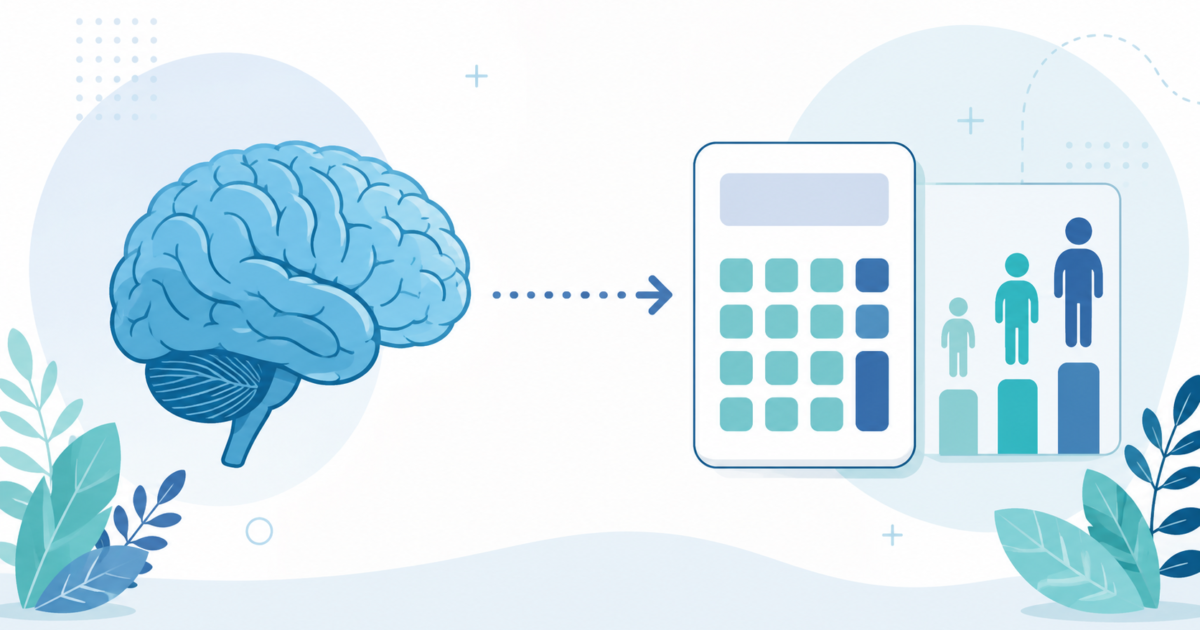
Ever taken one of those online quizzes that spits out a number and tells you your “mental age” is 34, even though you’re 22? It’s a fun little party trick, but there’s actual psychology behind the idea — and it’s a lot older than the internet quiz that got you curious. If you want to know how to calculate mental age properly, where the concept came from, and why psychologists today treat it more as a historical curiosity than a diagnostic tool, you’re in the right place.
By the end of this guide, you’ll understand the original formula, see it worked out with real numbers, know what a modern mental age calculator actually does behind the scenes, and understand exactly where this concept still holds up — and where it falls apart.
Note: This article and any related mental age calculator or quiz on this site are intended for educational and entertainment purposes only. They are not a clinical or diagnostic psychological assessment, and results shouldn’t be used to make decisions about learning, development, or mental health. If you have concerns in these areas, talk to a licensed psychologist or your doctor.
What Is Mental Age, Really?
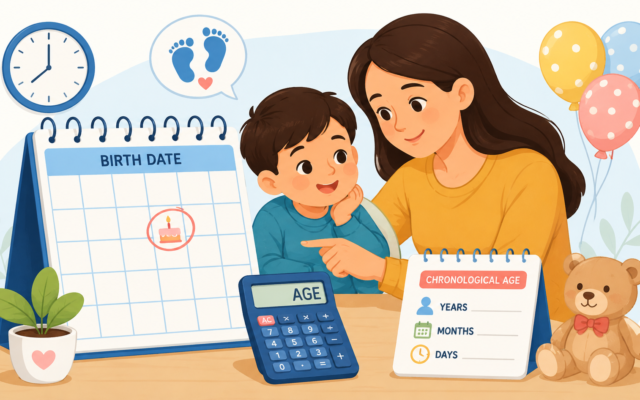
Mental age is a way of describing someone’s cognitive abilities by comparing them to the “typical” abilities of people at a certain age. If a 9-year-old solves problems the way an average 12-year-old would, that child is said to have a mental age of 12, even though their chronological age — the number of years they’ve actually been alive — is still 9.
It’s important to be clear about what this is not. Mental age isn’t a measure of maturity, wisdom, or how “grown up” someone acts. It’s not about emotional intelligence, either, even though people often use the term casually that way (“he’s got the mental age of a toddler”). In its original, technical sense, mental age refers strictly to performance on standardized cognitive tasks — things like memory, reasoning, vocabulary, and problem-solving — measured against age-based norms.
A Quick History Lesson: Where Mental Age Came From
The concept didn’t originate as an internet quiz gimmick. It came out of early 20th-century France, where the government needed a practical way to identify schoolchildren who required extra academic support.
Alfred Binet’s Contribution
In 1905, psychologist Alfred Binet, working alongside physician Théodore Simon, developed what became known as the Binet-Simon scale. Their goal was straightforward: create a test that could measure a child’s reasoning and problem-solving skills, then compare that performance to what was typical for children of various ages.
Binet didn’t intend for his test to label children as permanently “smart” or “slow.” He was fairly explicit that intelligence was complex and shaped by environment, and he worried his scale might be misused to sort children rigidly. His original purpose was practical and compassionate: identify kids who needed extra classroom support early, before they fell too far behind.
The test worked by giving children a series of tasks arranged by increasing difficulty, matched to the age at which most children could complete them. If a child could complete tasks typically solved by 8-year-olds but struggled with 9-year-old-level tasks, their mental age was recorded as 8, regardless of their actual birth year.
German psychologist William Stern later took this idea a step further. In 1912, he proposed dividing mental age by chronological age to create a ratio — the foundation of what we now call the intelligence quotient, or IQ.
Mental Age vs. Chronological Age vs. Cognitive Age vs. Psychological Age
These four terms get mixed up constantly, so let’s untangle them.
| Term | What It Actually Measures | How It’s Determined |
|---|---|---|
| Chronological age | Time elapsed since birth | Calendar date of birth vs. today’s date |
| Mental age | Cognitive performance compared to age norms | Standardized reasoning/problem-solving tests |
| Cognitive age | A broader, informal term for how “sharp” someone seems mentally, often used in aging and marketing research | Self-report surveys, perception-based studies |
| Psychological age | How old someone feels or behaves emotionally and socially | Subjective self-assessment, behavioral observation |
Chronological age is objective and never in dispute — it’s just math based on your birth date. The other three are interpretive to varying degrees, and only mental age has a formal, historical calculation method behind it.
How Mental Age Is Calculated
Here’s the part most people actually came here for. The original method Binet and Simon used was fairly simple in concept, even if the underlying test items were carefully designed.
The process:
- A person completes a series of standardized tasks grouped by the age at which most people can solve them.
- The tester finds the highest age level at which the person can consistently pass the tasks.
- That age level becomes the person’s mental age.
There wasn’t a complicated equation for finding mental age itself — it was determined by matching test performance to age-graded norms. The formula comes in when you use mental age to calculate IQ.
The Original IQ Formula (Using Mental Age)
Stern’s ratio IQ formula looks like this:
IQ = (Mental Age ÷ Chronological Age) × 100
Multiplying by 100 removes the decimal and gives a clean, comparable number. A ratio IQ of 100 means someone’s mental age matches their chronological age exactly — performing “as expected” for their age group.
Worked Examples: Calculating Mental Age and IQ
Let’s put real numbers into the formula so it actually makes sense.
Example 1: A child performing above expected level
- Chronological age: 8
- Mental age (based on test performance): 10
- IQ = (10 ÷ 8) × 100 = 125
Example 2: A child performing at expected level
- Chronological age: 12
- Mental age: 12
- IQ = (12 ÷ 12) × 100 = 100
Example 3: A child performing below expected level
- Chronological age: 10
- Mental age: 8
- IQ = (8 ÷ 10) × 100 = 80
| Chronological Age | Mental Age | Ratio IQ Score |
|---|---|---|
| 6 | 7 | 116.7 |
| 8 | 10 | 125 |
| 10 | 8 | 80 |
| 12 | 12 | 100 |
| 15 | 18 | 120 |
Notice something important: this formula gets weird once you’re an adult. Cognitive development levels off in early adulthood, so comparing a 40-year-old’s mental age to their chronological age using this ratio doesn’t produce meaningful results. That’s one of the main reasons psychologists abandoned ratio IQ decades ago.
How Modern Mental Age Tests Differ From the Original
Binet’s era relied on age-graded task sets and manual scoring by a trained examiner. Today’s approach is fundamentally different.
| Feature | Historical Method (Early 1900s) | Modern Method |
|---|---|---|
| Scoring basis | Mental age compared to chronological age | Deviation IQ compared to a statistical norm group |
| Administered by | Trained psychologist, in person | Standardized digital or paper tests, often computer-scored |
| Used for | Identifying children needing school support | Clinical assessment, research, educational placement |
| Adult applicability | Poor — mental age plateaus in adulthood | N/A — deviation IQ works across all ages |
| Statistical basis | Simple ratio | Normal distribution, standard deviation |
Modern IQ tests, like the Wechsler scales, use what’s called deviation IQ instead of ratio IQ. Instead of dividing mental age by chronological age, your score is calculated based on how far you fall from the average score of people your own age, using a standard deviation of 15 points. This fixes the adult-comparison problem entirely, since you’re always being compared to people in your own age bracket rather than to an abstract “mental age” milestone.
Can Adults Really Have a “Mental Age”?
Technically, no — not in the way Binet originally defined it. Cognitive development, in the sense the original scale measured, largely stabilizes by the late teens or early twenties. There’s no meaningful “18-year-old” versus “45-year-old” mental age distinction the way there is between an 8-year-old and a 12-year-old.
That hasn’t stopped the term from taking on a second life. Online quizzes that assign adults a “mental age” are almost always measuring something closer to personality traits, humor style, media preferences, or lifestyle habits — not cognitive ability in the Binet-Simon sense. They’re entertaining, but they’re not psychological assessments.
How Online Mental Age Calculators Actually Work
If you’ve used a mental age calculator or taken a mental age quiz online, here’s what’s typically happening behind the scenes:
- Question banks: A set of multiple-choice or scenario-based questions covering logic, general knowledge, preferences, or reaction-based scenarios.
- Weighted scoring: Each answer is assigned a point value or category tag.
- Algorithmic mapping: Your total score gets mapped to an age range using a predetermined formula or lookup table built by the site’s developer — not a clinically validated norm group.
- Instant results: The tool displays your “mental age” immediately, often with a shareable graphic for social media.
Some tools genuinely try to base their questions on cognitive psychology principles — memory recall, pattern recognition, processing speed. Others are built purely for entertainment and use humor or lifestyle questions with no real cognitive basis at all.
Limitations of Online Mental Age Calculators
- They’re not standardized against a scientifically validated population sample.
- Results can vary wildly between different calculators for the same person.
- They can’t account for test anxiety, distractions, or a bad day.
- They often blend cognitive, emotional, and lifestyle factors into one score, which muddies what’s actually being measured.
- They’re not created or reviewed by licensed psychologists in most cases.
Think of them the same way you’d think of a “which decade do you belong in” quiz — fun, shareable, not something to build decisions around.
What Actually Affects Mental Age (or Cognitive Performance)
Whether we’re talking about the historical concept or the modern idea of “cognitive sharpness,” several real, research-backed factors influence performance on the kinds of tasks these tests use:
- Learning and education — consistent exposure to problem-solving and new information strengthens reasoning skills.
- Memory — both working memory and long-term recall affect how quickly someone processes test items.
- Problem-solving practice — familiarity with logic puzzles or pattern recognition genuinely improves performance on similar tasks.
- Emotional maturity — while not part of the original definition, emotional regulation affects test performance indirectly by influencing focus and stress response.
- Environment — access to books, mentally stimulating conversation, and educational resources during childhood shapes cognitive development.
- Brain development and health — sleep, nutrition, physical activity, and overall brain health all influence cognitive test performance at any age.
Can You Improve Your Mental Age?
If we’re talking about the entertainment-style “mental age” quizzes, the honest answer is that they’re not really measuring something you need to “improve.” But if we’re talking about the underlying cognitive skills — memory, reasoning, processing speed — there’s solid psychological research supporting ways to keep your brain sharp:
- Stay mentally active. Puzzles, reading, and learning new skills keep reasoning circuits engaged.
- Prioritize sleep. Memory consolidation happens largely during sleep, and chronic sleep deprivation measurably hurts cognitive test performance.
- Get regular physical exercise. Cardiovascular exercise has been linked to better memory and executive function in numerous studies.
- Keep learning something new. Picking up a language, instrument, or unfamiliar skill builds neural connections that support broader cognitive flexibility.
- Manage stress. Chronic stress impairs memory and focus, both of which affect performance on any cognitive task.
- Stay socially engaged. Regular social interaction is associated with better long-term cognitive health.
None of these will change a number on a quiz overnight, but they genuinely support the cognitive functions those quizzes are loosely trying to measure.
Common Myths About Mental Age
Myth: A low mental age score means someone isn’t intelligent. Mental age was never meant to be a complete measure of intelligence, even in Binet’s original design. It reflects performance on specific tasks at a specific point in time.
Myth: Adults have a scientifically measurable mental age. As covered above, this isn’t how the concept works past the point where cognitive development levels off. Adult-focused “mental age” quizzes are almost always personality- or lifestyle-based.
Myth: Online calculators are clinically accurate. Unless a tool explicitly states it’s based on validated psychological assessment methods and normed against a real population sample, treat the result as entertainment.
Myth: Mental age and IQ are the same thing. Mental age is one input into the old ratio IQ formula. Modern IQ scores don’t use mental age at all — they use deviation-based statistical comparisons.
Myth: A high “mental age” is always a good thing. Even in Binet’s framework, an unusually high mental age relative to chronological age wasn’t inherently “better” — it simply indicated advanced performance on that specific test at that specific time.
When Is Mental Age Actually Used Today?
The term does still show up in specific, limited contexts:
- Historical and educational psychology courses, where it’s taught as the foundation of intelligence testing.
- Certain developmental assessments for children, where comparing a child’s skills to typical age-based milestones can help identify areas that may benefit from additional support — though modern assessments use far more nuanced tools than the original Binet-Simon scale.
- Discussions of intellectual disability history, since mental age was historically used (and is now considered outdated and sometimes stigmatizing) in diagnostic classification.
Why Psychologists Rarely Rely on Mental Age Alone
Modern psychology has largely moved past mental age as a standalone metric for several solid reasons:
- It breaks down mathematically in adulthood, since cognitive milestones stop mapping neatly onto age.
- Deviation IQ provides a statistically sounder way to compare someone’s performance to their actual peer group.
- A single number can’t capture the many distinct types of intelligence — verbal, spatial, logical, and so on — that modern testing tries to measure separately.
- Relying on one score risks oversimplifying a person’s abilities, which can lead to unfair labeling, especially in educational settings.
Today’s assessments, like the Wechsler Intelligence Scales, break results into multiple index scores rather than reducing someone to a single “mental age” figure.
Advantages and Limitations at a Glance
| Advantages of the Mental Age Concept | Limitations |
|---|---|
| Historically important — laid the foundation for modern IQ testing | Doesn’t work well for adults |
| Simple, intuitive way to explain relative cognitive performance in children | Oversimplifies intelligence into one number |
| Still useful for teaching the history of psychology | Replaced by more statistically sound methods (deviation IQ) |
| Easy starting point for informal comparison | Online versions are rarely scientifically validated |
Final Thoughts
Mental age is one of those ideas that sounds simple on the surface but carries a surprisingly rich history. What started as Alfred Binet’s practical solution for identifying schoolchildren who needed extra support eventually shaped the entire framework of modern intelligence testing — even as psychologists moved past the original ratio-based formula in favor of more statistically reliable methods.
If you’re using a mental age calculator or taking a mental age quiz online, it’s fine to enjoy it for what it is — a fun way to reflect on how you think, learn, and solve problems. Just keep in mind that it’s an educational concept rooted in early 20th-century psychology, not a complete or clinically precise measure of your intelligence. Understanding how to calculate mental age gives you a much better lens for interpreting those results — and for appreciating just how far intelligence testing has evolved since 1905.
Frequently Asked Questions
How do you calculate mental age? Traditionally, mental age was determined by finding the highest age level of standardized tasks a person could reliably complete, based on the Binet-Simon testing approach. It wasn’t calculated with a formula on its own — the formula (Mental Age ÷ Chronological Age × 100) was used afterward to calculate ratio IQ.
Can adults have a mental age? Not in the strict, original scientific sense, since cognitive development levels off by early adulthood. Adult-focused mental age quizzes online are typically measuring personality or lifestyle traits rather than true cognitive age.
Is mental age real? It’s a real historical psychological concept with documented origins, but it’s largely been replaced by more accurate testing methods like deviation IQ.
What is the formula for mental age? There isn’t a standalone formula for finding mental age itself — it comes from matching test performance to age-based norms. The related IQ formula is Mental Age ÷ Chronological Age × 100.
Can mental age change? The underlying cognitive skills it was meant to reflect — memory, reasoning, problem-solving — can improve or decline over time based on health, learning, and lifestyle factors.
Are online mental age tests accurate? Generally no, not in a clinical sense. Most are built for entertainment and aren’t validated against real psychological norms.
What affects mental age? Education, memory, problem-solving practice, brain health, sleep, and environment all influence the cognitive skills mental age was designed to measure.
Who invented mental age? Alfred Binet, along with Théodore Simon, introduced the concept in 1905 through the Binet-Simon intelligence scale.
What is the difference between IQ and mental age? Mental age is a comparison of task performance to age norms. IQ, especially modern deviation IQ, is a statistical score comparing your performance to others in your specific age group, using standard deviation rather than a simple ratio.
Should I trust free mental age calculators? Treat them as entertainment rather than clinical assessment tools, unless the site explicitly states it uses a validated psychological methodology.