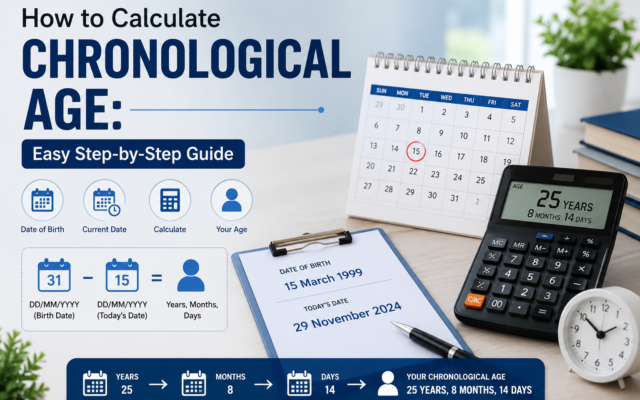
Age Calculator by Date: The Complete Guide to Finding Your Exact Age

Have you ever been asked your exact age — not just in years, but in months and days too — and found yourself doing awkward math on your fingers? You’re not alone. Most of us know our age in round numbers, but the real, precise figure is trickier to work out than it seems, especially once leap years get involved.
That’s exactly why an age calculator by date is so useful. Instead of counting on your fingers or scribbling on a napkin, you simply enter your date of birth, and within a second you get your exact age broken down into years, months, weeks, and days. It’s fast, it’s accurate, and it removes all the guesswork.
In this guide, we’ll walk through everything you need to know about calculating age from a date of birth — how online tools work, how to do it manually, why leap years complicate things, and where exact age calculations actually matter in real life. Whether you’re filling out a school form, checking eligibility for a job, or just curious, you’ll find a clear answer here. And when you’re ready to skip the manual math entirely, our Chronological Age Calculator is ready to do the work for you.
Think about the last time someone asked your exact age and you paused. Maybe it was a doctor’s office intake form, a job application, or a school registration desk. In each of those moments, “I’m 31” wasn’t enough — someone needed to know 31 years, how many months, and sometimes even how many days. That level of detail is where most people stumble, not because the math is impossible, but because it requires tracking multiple calendar rules at once: how many days are in each month, whether this year is a leap year, and whether your birthday for the current year has already passed. A dedicated calculator handles all of that instantly, which is exactly why this tool has become a daily-use utility for parents, students, HR professionals, and anyone who simply wants a fast, correct answer.
What Is an Age Calculator by Date?
An age calculator by date is a simple online tool that takes your date of birth and a reference date (usually today) and instantly tells you how much time has passed between the two. Rather than giving you just a single number of “years old,” a good calculator breaks the result down into multiple units — years, months, weeks, days, and sometimes even hours and minutes.
This is different from just subtracting birth year from the current year. That basic method often gives the wrong answer because it doesn’t account for whether your birthday has already happened this year. A true date of birth calculator looks at the full calendar — day, month, and year — to give you a precise, error-free result.
At its core, this kind of tool answers one question with total accuracy: exactly how old am I (or someone else) right now, down to the day?
The term “chronological age” is worth understanding on its own, since you’ll see it used throughout this article and across most reputable age-calculation resources. Chronological age simply means the actual amount of time that has passed since a person’s birth, measured strictly by the calendar. It’s different from concepts like “biological age” (a measure of how your body is aging based on health markers) or “mental age” (a comparative measure of cognitive development). When someone says “calculate chronological age,” they mean the precise, calendar-based number — which is exactly what a proper date of birth calculator is designed to produce. If you’re curious how mental age compares to your actual chronological age, our Mental Age Calculator offers a lighthearted way to explore that difference.
Why Use an Online Age Calculator?
You might be wondering — why not just do the math yourself? For simple cases, you can. But age calculation gets surprisingly messy once you factor in things like:
- Leap years adding an extra day to February
- Months with different numbers of days (28, 29, 30, or 31)
- Time zones, if you’re calculating for someone born in a different region
- The need for extreme precision in legal, medical, or academic contexts
An online age calculator removes all of that friction. Here’s why people reach for one instead of doing it by hand:
- Speed: Get a result in under a second, no calculator app or spreadsheet needed.
- Accuracy: No risk of forgetting a leap year or miscounting days in a month.
- Convenience: Works on any device — phone, tablet, or desktop — anywhere you have internet access.
- Multiple formats: See your age in years, months, weeks, and days all at once, instead of just one number.
- Free access: Most tools, including ours, are completely free with no sign-up required.
Quick Tip: If you only need your age in complete years, a quick calculation works fine. But if you need your exact age for a form, application, or eligibility check, always use a dedicated calculator to avoid small errors that can cause big problems later.
How an Age Calculator Works
Behind the simple interface, an age calculator is doing a bit of calendar logic every time you hit “calculate.” Here’s a plain-English breakdown of what happens:
- You enter your date of birth — day, month, and year.
- The tool captures the reference date — typically today’s date, though many calculators (including ours) let you calculate age as of any custom date.
- It calculates the difference between the two dates, working through years first, then months, then days.
- It adjusts for calendar irregularities, such as leap years and months with fewer than 31 days, so the final number is precise.
- It displays the result, usually broken into years, months, and days, with many tools also offering weeks, total days, hours, and even minutes.
This might sound simple, but the adjustment step (step 4) is where manual calculations usually go wrong. A well-built exact age calculator handles this automatically, which is why it consistently outperforms mental math or basic subtraction.
How to Calculate Age Manually
Even though online tools make this effortless, it’s still worth understanding how to calculate age manually — both for general knowledge and for double-checking a result. Here’s a simple step-by-step method.
Step 1: Write Down Both Dates
Let’s say your date of birth is 14 March 1995, and you want to know your age as of 2 August 2026.
Step 2: Subtract the Years
2026 − 1995 = 31 years (this is a starting estimate, not the final answer yet).
Step 3: Check If the Birthday Has Occurred This Year
Since March 14 has already passed by August 2, your birthday this year has occurred. So the year count of 31 stays as-is. If today’s date were before March 14, you’d subtract 1 from the year total.
Step 4: Calculate Remaining Months and Days
From March 14 to August 2:
- March 14 to August 14 = 5 months
- August 14 back to August 2 = minus 12 days
So the result is 5 months minus 12 days, which converts to 4 months and 19 days (borrowing days from the previous month, similar to how you’d borrow in subtraction).
Final Manual Result
31 years, 4 months, and 19 days old.
This method works well for most people, but it’s easy to make a small error, especially around month-end dates or leap years. That’s exactly the kind of mistake an automated birth date calculator eliminates.
Formula Used for Age Calculation
If you prefer thinking in formulas rather than steps, here’s the logic most calculators (and spreadsheet formulas) follow:
Age (years) = Current Year − Birth Year
If (Current Month, Day) < (Birth Month, Day):
    Age (years) = Age (years) − 1
For a more granular breakdown into years, months, and days, the calculation typically works like this:
1. Start with Years = Current Year − Birth Year
2. Start with Months = Current Month − Birth Month
3. Start with Days = Current Day − Birth Day

4. If Days is negative:
   - Borrow days from the previous month
   - Subtract 1 from Months

5. If Months is negative:
   - Add 12 to Months
   - Subtract 1 from Years
This is essentially the same borrowing logic taught in basic subtraction, just applied to calendar units instead of plain numbers. It’s a reliable formula, but as you can see, it requires careful attention to detail — which is precisely why a calculate chronological age tool is so handy for everyday use.
Age Calculation Examples
Let’s walk through a few real-world examples to see this in action.
Example 1: Simple Case (Birthday Already Passed)
- Date of Birth: 10 January 2000
- Today’s Date: 2 August 2026
- Result: 26 years, 6 months, 23 days
Example 2: Birthday Hasn’t Occurred Yet This Year
- Date of Birth: 25 December 1998
- Today’s Date: 2 August 2026
- Result: 27 years, 7 months, 8 days (since the birthday hasn’t occurred yet, one year is subtracted from the initial estimate)
Example 3: Born on a Leap Day
- Date of Birth: 29 February 2000
- Today’s Date: 2 August 2026
- Result: 26 years, 5 months, 4 days
This last example is a great one to understand, since it leads directly into our next section — because someone born on February 29 technically only has a “true” birthday once every four years.
| Example | Date of Birth | As of Date | Exact Age |
|---|---|---|---|
| 1 | 10 Jan 2000 | 2 Aug 2026 | 26 years, 6 months, 23 days |
| 2 | 25 Dec 1998 | 2 Aug 2026 | 27 years, 7 months, 8 days |
| 3 | 29 Feb 2000 | 2 Aug 2026 | 26 years, 5 months, 4 days |
Why Leap Years Matter
Leap years exist because Earth’s orbit around the sun takes approximately 365.25 days, not exactly 365. To keep our calendar aligned with the seasons, an extra day (February 29) is added every four years — with a few exceptions for century years not divisible by 400.
Here’s why this matters for age calculation:
- People born on February 29 only have an actual calendar birthday once every four years. Most age calculators treat their “legal” birthday as either February 28 or March 1 in non-leap years.
- Leap years affect day counts. If you’re calculating someone’s age in total days, forgetting to account for leap years will throw off the number by one or more days per leap year included in the range.
- Manual calculations are more error-prone around leap years, since it’s easy to forget whether a particular year had 365 or 366 days.
Tip Box: If your date range spans multiple decades, there could be 5, 10, or even 20+ leap years involved. A reliable online age calculator automatically accounts for every single one, so you never have to worry about miscounting.
Age in Years, Months, Weeks, Days, Hours and Minutes
One of the best features of a good age calculator by date is that it doesn’t just give you one number — it shows your age in multiple units simultaneously. This is useful because different situations call for different formats.
| Unit | Best Used For |
|---|---|
| Years | General reference, ID documents, forms |
| Months | Infant and toddler development tracking |
| Weeks | Pregnancy tracking, newborn care |
| Days | Precise legal or medical calculations |
| Hours | Fun facts, milestone tracking |
| Minutes | Novelty calculations, birthday countdowns |
For instance, if you were born on 10 January 2000, as of 2 August 2026, your age calculator in months result would show approximately 319 months, while your age calculator in weeks result would show roughly 1,386 weeks. Seeing your age from these different angles can be genuinely eye-opening — and sometimes just plain fun.
If you’re also curious about your age relative to a specific milestone, like the exact midpoint between two birthdays, our Half Birthday Calculator can show you precisely when your half-birthday falls each year.
Common Uses of Age Calculators
Exact age calculations aren’t just a curiosity — they’re genuinely required in many practical situations. Here’s where they matter most.
Education
Schools often have strict age cutoffs for kindergarten or first-grade enrollment. A child needs to be a certain age by a specific date, and being even a day off can affect eligibility.
Medical Assessments
Doctors and nurses frequently need a patient’s exact age — particularly for infants, where age in weeks or months affects dosing, developmental milestones, and vaccination schedules.
School Admissions
Universities and colleges sometimes set age-based eligibility for certain programs, scholarships, or age-restricted competitions, requiring exact date-based verification.
Employment
Certain jobs have minimum age requirements, and HR departments must verify exact age from date of birth documentation during hiring.
Government Forms
Passport applications, ID renewals, tax documents, and voter registration often require an exact date of birth and calculated age as of the application date.
Insurance
Insurance premiums, especially for life and health insurance, are frequently calculated based on exact age, sometimes down to the number of days.
Sports Eligibility
Youth sports leagues almost always have strict age brackets, and athletes must fall within a specific age range as of a designated cutoff date to compete.
Real-Life Example: A parent registering their child for a youth soccer league discovers the cutoff date requires the child to be “under 10” as of September 1. Because the child’s birthday falls in late August, the days matter enormously — an age difference calculator helps confirm eligibility instantly, without any guesswork.
Benefits of Using Our Chronological Age Calculator
Our Chronological Age Calculator is built specifically to make exact age calculation effortless and reliable. Here’s what sets it apart:
- Instant, accurate results — calculated in years, months, weeks, and days simultaneously
- Leap year aware — automatically accounts for every leap year in the date range
- Free to use — no sign-up, no downloads, no hidden fees
- Mobile-friendly — works smoothly on phones, tablets, and desktops
- Flexible reference dates — calculate age as of today or any custom date
- Privacy-respecting — your date of birth isn’t stored or shared
Beyond the standard age calculation, our site also offers related tools worth exploring:
- The Mental Age Calculator for a fun comparison between chronological and mental age
- The Half Birthday Calculator to find the exact midpoint of your birth year
- Our Percentage Calculators Hub for a full range of everyday percentage tools
Each of these tools is designed with the same principle in mind: take a calculation that’s normally tedious or error-prone and make it instant and reliable.
Common Age Calculation Mistakes
Even careful people make mistakes when calculating age manually. Here are the most common ones to watch for.
- Simple year subtraction without checking the birthday. Subtracting birth year from current year only works if the birthday has already occurred this year.
- Forgetting leap years entirely. This throws off day-based calculations, especially over longer time spans.
- Miscounting days in a month. Not every month has 30 or 31 days — February is the classic trap.
- Confusing “age turns X” with “age is X.” Someone “turning 30” this year isn’t 30 until their actual birthday arrives.
- Ignoring time zones for exact time-based calculations. This matters mainly for hour- and minute-level precision, such as newborn tracking.
- Using outdated or incorrect reference dates. Always double-check that you’re calculating “as of” the correct date, especially for forms with specific deadlines.
Accuracy Note: For everyday curiosity, small errors don’t matter much. But for legal documents, medical records, or eligibility verification, even a one-day discrepancy can cause real problems. When precision matters, always verify results using a dedicated exact age calculator, and consider professional verification for legal or medical documentation.
Final Thoughts: Get Your Exact Age in Seconds
Calculating your exact age doesn’t have to involve mental gymnastics or a risk of small errors. Whether you’re figuring out eligibility for school, double-checking a form, or simply satisfying your own curiosity, a reliable age calculator by date takes the guesswork out of the equation entirely.
We’ve covered how these tools work, how to calculate age manually if you ever need to, the role leap years play, and where exact age calculations matter most in daily life. Armed with that knowledge, you’re ready to get a precise answer whenever you need one.
Ready to see your exact age broken down into years, months, weeks, and days? Head over to our Chronological Age Calculator and get your instant, accurate result — completely free, with no sign-up required.
Frequently Asked Questions
1. What is an age calculator by date? It’s an online tool that calculates your exact age by comparing your date of birth to a reference date, typically today, and displays the result in years, months, weeks, and days.
2. How accurate are online age calculators? Reputable calculators, including ours, are highly accurate because they account for calendar irregularities like leap years and varying month lengths automatically.
3. Can I calculate someone else’s age, not just my own? Yes. Simply enter the other person’s date of birth instead of your own. This is common for calculating a child’s, parent’s, or relative’s exact age.
4. Does the calculator account for leap years? Yes, a properly built chronological age calculator automatically factors in every leap year within the date range for precise results.
5. What if I was born on February 29? Most calculators treat your birthday as either February 28 or March 1 in non-leap years for the purpose of calculating your current age.
6. Can I calculate my age as of a future or past date, not just today? Yes, many tools, including ours, let you set a custom reference date instead of only using today’s date.
7. How do I calculate my age in months instead of years? An age calculator in months converts your total age into completed months rather than years, which is useful for infant development tracking.
8. Why does my age in weeks seem like such a large number? Because a year contains roughly 52.14 weeks, so even a modest age in years translates to a much larger number when converted to weeks.
9. Is there a difference between “age” and “chronological age”? Chronological age specifically refers to the actual time elapsed since birth, as opposed to concepts like mental age or biological age, which measure different things entirely.
10. Can I use this tool for legal or official documents? Our calculator provides accurate results for reference purposes, but for official legal, medical, or government documentation, always verify with the relevant authority or professional.
11. How do I calculate the age difference between two people? An age difference calculator subtracts one birth date from another to show exactly how many years, months, and days separate the two people