
UK Share Incentive Plan Calculator: Calculate SIP Shares, Tax Benefits & Value

If your employer offers a Share Incentive Plan, working out what it’s actually worth to you isn’t always straightforward. A UK Share Incentive Plan calculator helps you turn your salary contribution, your employer’s matching ratio and any free shares on offer into a single, understandable estimate: how many shares you could end up with, and roughly what they might be worth.
A Share Incentive Plan (SIP) is one of the UK’s HMRC-approved employee share schemes, designed to let staff buy a stake in the company they work for, often with generous help from their employer and favourable tax treatment along the way. For many employees, the numbers involved — partnership shares, matching shares, free shares, dividend shares — can feel like a lot to keep track of, especially when the value of what you hold changes with the share price.
That’s where a SIP calculator earns its keep. It can help you estimate your monthly and annual contributions, the number of partnership shares those contributions might buy, how many matching shares your employer could add on top, and how the total pot might grow over time. Understanding how free, partnership, matching and dividend shares interact matters because each one is governed by its own rules and limits — and because SIPs, unlike a generic savings or investment product, are entirely UK-specific, shaped by HMRC legislation rather than general market conventions.
This article walks through how a SIP works, what a calculator can (and can’t) tell you, and the tax rules worth understanding before you decide how much to contribute.
What Is a Share Incentive Plan (SIP)?

A Share Incentive Plan is a government-approved scheme that lets UK employers give employees shares in the company, or help them buy shares, in a tax-advantaged way. SIPs sit alongside other approved schemes such as Save As You Earn (SAYE), Enterprise Management Incentives (EMIs) and Company Share Option Plans (CSOPs), but they work differently: rather than granting options over shares at a future date, a SIP puts real shares into a trust on your behalf, generally from day one.
The purpose is straightforward: to widen employee share ownership. Because a SIP has to be offered to all eligible employees on broadly similar terms, it isn’t a scheme reserved for directors or senior staff — a company running a SIP has to make it available across the workforce, sometimes after a qualifying period of employment.
Shares awarded or purchased through a SIP are held in an HMRC-approved trust rather than sitting directly in your own brokerage account. This trust structure is central to how the tax advantages work, since the length of time shares stay in the trust affects what Income Tax and National Insurance treatment applies when they eventually come out.
HMRC recognises four types of SIP shares, and it’s worth understanding each one separately before looking at a worked example:
- Free shares — awarded by the employer at no cost to the employee.
- Partnership shares — bought by the employee out of pre-tax, pre-National Insurance salary.
- Matching shares — additional free shares the employer provides based on how many partnership shares the employee buys.
- Dividend shares — bought using dividends paid on shares already held in the plan, where the employer’s scheme allows it.
Not every employer offers all four. Some run a free shares-only scheme; others focus on partnership and matching shares with no free-share element at all. What’s on offer, and on what terms, is set out in your employer’s specific SIP documentation.
As a simple example: an employee decides to buy partnership shares through payroll deduction, and the employer separately agrees to match those purchases at a set ratio. The partnership shares come from the employee’s own contribution; the matching shares are the employer’s top-up, awarded on the same schedule.
How Does a UK Share Incentive Plan Calculator Work?

A Share incentive plan calculator takes the inputs specific to your scheme and turns them into an estimate of your total shareholding and its potential value. The exact inputs vary between calculators, but a reasonably thorough one will typically ask for:
- Annual salary — used to check contribution limits tied to a percentage of income.
- Monthly salary contribution — how much you’re putting into partnership shares each pay period.
- Partnership-share contribution — the total amount deducted from salary over the year.
- Share price — the current price used to work out how many shares your contribution buys.
- Employer matching ratio — how many matching shares your employer provides per partnership share.
- Free-share value — any free shares awarded outside of your own contribution.
- Dividend reinvestment — whether dividends are being used to buy further shares.
- Expected share-price growth — an assumption about how the share price might change.
- Investment period — how many years you plan to hold the shares.
- Number of years — used to project contributions and matching shares across multiple tax years.
Each of these feeds into the underlying maths. Your monthly contribution, divided by the share price, gives a rough number of partnership shares bought each month. Multiply that by your employer’s matching ratio, and you get the matching shares added on top. Add any free shares awarded separately, and you have an estimated total shareholding for the year — before even considering share-price movement or dividends.
As an illustration: if an employee contributes £100 a month and the applicable share price is £10, that could buy in the region of 10 partnership shares a month, before considering the specific statutory and scheme limits that apply. Over a full tax year, that’s roughly £1,200 contributed and around 120 partnership shares purchased, assuming the share price stays flat.
Employer matching then increases the total. If the same employer matches at a ratio of 1:1, the employee could end up with roughly 120 matching shares on top of the 120 partnership shares — around 240 shares in total from that year’s contributions alone, before any free shares or dividend shares are added.
The actual outcome always depends on the employer’s specific SIP rules, including how frequently shares are purchased, whether there’s a minimum contribution, and how the matching ratio is applied in practice.
The Four Types of SIP Shares
Free Shares
Free shares are exactly what the name suggests: shares awarded to eligible employees by the employer, at no cost to the employee. Not every SIP includes a free-share element, but where it does, the employer decides how much to award, up to the statutory limit.
Under current HMRC rules, an employer can award free shares worth up to £3,600 per employee per tax year. This is not an automatic entitlement — it’s a ceiling on how much an employer can award tax-advantageously, and the actual amount awarded is entirely down to the scheme rules the employer sets.
The value of the shares is generally based on their market value at the time of award. Provided the shares stay within the SIP trust for the qualifying period, favourable Income Tax and National Insurance treatment can apply — though, as covered later, the treatment depends heavily on how long the shares are held and the circumstances in which they leave the plan.
Holding period matters here more than almost anywhere else in the scheme, because withdrawing free shares early can trigger a tax charge that simply doesn’t arise if they’re left in place for the full period.
Partnership Shares
Partnership shares are the shares an employee actively chooses to buy, funded through deductions from salary. The key advantage is that this contribution is typically made from pre-tax, pre-National Insurance salary under SIP rules, which is part of what makes the scheme attractive compared with buying shares through an ordinary dealing account.
The statutory annual limit is the lower of:
- £1,800 per tax year, or
- 10% of the employee’s income for the tax year
Whichever figure is smaller applies. For most average earners, £1,800 will be the binding limit; for someone on a lower salary, the 10%-of-income cap might bite first. Employers can also set their own minimum and maximum monthly contribution levels within these statutory boundaries, and some operate an “accumulation period” where contributions build up over several months before shares are actually purchased, rather than buying shares every single payday.
Share price at the point of purchase determines how many partnership shares a given contribution actually buys — a higher share price means fewer shares for the same amount of money, and vice versa.
Matching Shares
Matching shares are the employer’s way of rewarding participation: for every partnership share an employee buys, the employer can add a set number of additional shares, free of charge.
The maximum statutory matching ratio is up to two matching shares for every one partnership share an employee purchases. An employer can choose any ratio up to that maximum — common examples include 1:1 or 1:2 — but 2:1 represents the ceiling permitted under the rules.
This is often where a SIP delivers its most obvious value, because matching shares can significantly increase the total number of shares an employee ends up holding relative to what they’ve personally contributed.
As a numerical example: if an employee purchases 100 partnership shares over a tax year and the employer matches at a 2:1 ratio, the employee could receive up to 200 matching shares in addition — meaning 300 total shares from an outlay that only directly purchased 100 of them.
Matching shares are commonly subject to a forfeiture period, often up to three years, during which leaving the company (outside of specific “good leaver” circumstances) can mean losing the matching shares that haven’t yet vested. It’s worth checking this detail in your own scheme’s documentation.
Dividend Shares
Dividend shares arise when dividends paid on shares already held in the SIP are reinvested to buy further shares, rather than being paid out as cash. Whether this is available at all depends entirely on the employer’s scheme — some SIPs allow it, others don’t.
Where dividend reinvestment is offered, it can meaningfully increase the number of shares held over time, particularly for employees who stay in the scheme for several years and consistently reinvest rather than taking dividends as income.
The tax treatment of dividend shares has its own nuances. They’re generally free of Income Tax and National Insurance at the point of purchase, but if an employee leaves the company and withdraws dividend shares within three years of the date they were awarded, different tax consequences can apply. It’s an area where the rules genuinely depend on timing, so it’s worth checking the specifics rather than assuming dividend shares are treated identically to free or matching shares.
SIP Share Limits in the UK
| SIP Share Type | What It Means | Current Statutory Limit/Rule |
|---|---|---|
| Free Shares | Shares awarded by employer | Up to £3,600 per tax year |
| Partnership Shares | Shares purchased from salary | Lower of £1,800 or 10% of income |
| Matching Shares | Employer-matched partnership shares | Up to 2 matching shares per partnership share |
| Dividend Shares | Shares bought using dividends | Subject to SIP rules, where offered |
These figures represent the maximum amounts permitted under the legislation — they are not guarantees of what any individual employer will actually offer. A company running a SIP might set lower internal limits, cap monthly contributions, or choose not to offer every share type at all. Always check your employer’s scheme rules and current HMRC guidance before making financial decisions based on these figures, since allowances can be revised in future Budgets or Finance Acts.
How Much Could Your SIP Be Worth?
Working out the potential value of a SIP means separating a few distinct things that are easy to conflate:
- Amount contributed — what you’ve actually put in from your own salary.
- Number of shares — how many shares that contribution, plus any employer top-up, has bought.
- Employer matching — the free shares added on top of your own purchases.
- Free shares — any separate award not tied to your contribution.
- Share-price growth — how the value of each share might change over time.
- Dividends — income paid on the shares, potentially reinvested as further shares.
- Total estimated value — the combined worth of everything above, at a given share price.
Two simplified examples make the relationship between these clearer.
Example 1: Basic SIP
An employee contributes £50 a month to partnership shares, with a share price of £5. Over 12 months:
- Contribution: £600
- Shares purchased: approximately 120
- No employer matching in this scenario
- Total shares: approximately 120
- Estimated value at £5/share: £600
Example 2: SIP With 2:1 Matching
Same employee, same £50 monthly contribution and £5 share price, but the employer now matches at 2:1:
- Contribution: £600
- Partnership shares purchased: approximately 120
- Matching shares (2:1): approximately 240
- Total shares: approximately 360
- Estimated value at £5/share: £1,800
The difference is entirely down to employer matching — the employee’s own outlay hasn’t changed, but the total shareholding has roughly tripled. These figures are illustrative only; actual share purchases depend on exact timing, rounding, and how the employer’s scheme processes contributions.
SIP Calculator Example
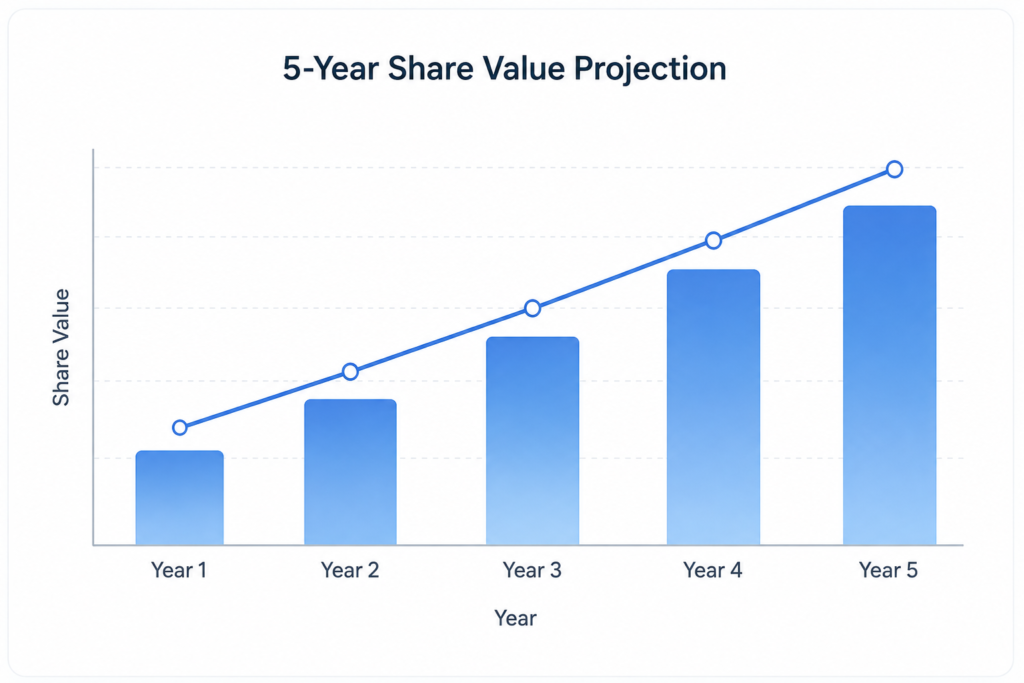
Here’s a more detailed worked example bringing several inputs together.
Assumptions:
- Employee salary: £40,000
- Monthly contribution: £100
- Annual contribution: £1,200
- Share price at purchase: £20
- Matching ratio: 2:1
- Investment period: 5 years
At a £20 share price, £1,200 a year in partnership share contributions buys approximately 60 partnership shares annually. With 2:1 matching, the employer adds approximately 120 matching shares each year. That’s roughly 180 total shares added per year, or around 900 shares over the full five-year period, assuming a constant share price and contribution level (in practice, both would typically vary year to year).
The real uncertainty, of course, is what those shares will be worth by the time the five years are up. The table below shows how the estimated value of a holding of 900 shares changes under a range of hypothetical future share prices — this is an illustration of sensitivity, not a prediction of where the share price will actually go.
| Future Share Price | Estimated Share Value (900 shares) |
|---|---|
| £15 | £13,500 |
| £20 | £18,000 |
| £25 | £22,500 |
| £30 | £27,000 |
| £40 | £36,000 |
Share prices can fall as well as rise, and a company’s share price performance is never guaranteed. This table exists purely to show how sensitive the final value is to future share-price movement — it isn’t a forecast for any real company.
SIP Tax Benefits in the UK
The tax treatment of SIP shares is one of the main reasons employees consider them worth participating in, but it’s more nuanced than a blanket “tax-free” label.
Income Tax and National Insurance: Partnership share contributions are typically deducted from gross salary, before Income Tax and National Insurance are calculated on that portion — an immediate saving compared with buying shares out of net pay. Free shares, matching shares and dividend shares can also escape Income Tax and NIC charges, but this generally depends on the shares remaining in the SIP trust for the relevant holding period.
Holding periods: HMRC guidance indicates that SIP shares kept in the plan for five years can receive significant Income Tax and National Insurance advantages — in many cases, no Income Tax or NIC charge at all when the shares eventually leave the plan. Shares withdrawn earlier than five years can be subject to a charge, calculated with reference to their value either at the date of award or the date of withdrawal, depending on the type of share and how long it was held.
Capital Gains Tax: While shares remain inside the SIP trust, there’s generally no Capital Gains Tax to consider on any growth in value. If shares are sold directly out of the trust, any gain accrued while they were held in the SIP is typically outside the scope of CGT. However, if shares are transferred out of the trust into an employee’s own name and later sold, CGT may apply to any subsequent gain from that point onward — so how and when shares are disposed of matters for CGT purposes, not just for Income Tax.
None of this means every SIP transaction is automatically tax-free. The favourable treatment is conditional — on the type of share, the length of time it’s been held, and the circumstances of withdrawal (voluntary sale, leaving employment, and so on). For current, detailed rules, HMRC’s own guidance and the Employee Tax Advantaged Share Scheme User Manual are the authoritative source.
What Happens If You Keep SIP Shares for 5 Years?
The five-year mark is the point at which SIP shares generally reach their most favourable tax position. Shares that have been held in the plan for the full five years and are then withdrawn or sold are typically free of Income Tax and National Insurance on their value, regardless of how much the share price has moved since they were awarded or purchased.
Capital Gains Tax is treated separately: if the shares are sold directly from the trust, any growth is generally outside CGT altogether. If they’re transferred into the employee’s own name first, CGT would only apply to gains made after that transfer — the growth that happened while the shares sat in the trust remains outside its scope.
Some schemes also allow shares to be transferred into a Stocks and Shares ISA within 90 days of leaving the SIP, where the employer’s scheme and HMRC rules permit it, which can preserve a tax-efficient wrapper for the shares going forward rather than holding them in an ordinary dealing account.
In practical terms: an employee who leaves their partnership shares, matching shares and free shares untouched for five years is generally in the strongest tax position the scheme offers, compared with withdrawing earlier.
What Happens If You Take SIP Shares Out Early?
Withdrawing shares before the relevant holding period has elapsed can change the tax outcome, and the treatment isn’t identical across share types:
- Free shares and matching shares withdrawn within three years of award are generally subject to Income Tax and National Insurance on their market value at the point of withdrawal.
- Partnership shares can typically be withdrawn at any time, since they were bought with the employee’s own money — but withdrawal within three years of purchase can still trigger Income Tax and NIC on their value at that point.
- Dividend shares withdrawn within three years of the reinvestment date can also be subject to Income Tax.
- Shares withdrawn between three and five years after award or purchase are often taxed on the lower of their value at award/purchase and their value at withdrawal, rather than full market value at withdrawal — a more favourable outcome than an early withdrawal in year one or two, but still less favourable than waiting the full five years.
Leaving employment can also affect the treatment. If you leave your job, what happens to unvested matching shares, or to shares still within their holding period, depends on your employer’s scheme rules. Many schemes include “good leaver” provisions — covering circumstances such as redundancy, retirement, ill health, or death — where shares may retain more favourable tax treatment despite an early exit, even though the general early-withdrawal rules would otherwise apply. Whether you qualify as a good leaver, and what that means for your specific shares, is set out in your employer’s plan documentation rather than in generic guidance.
None of this constitutes personalised tax advice — anyone facing an actual withdrawal decision should check their scheme rules and, where the numbers are significant, speak to a qualified adviser.
SIP Calculator vs Normal Investment Calculator
A SIP calculator and a standard investment calculator look similar on the surface — both project a contribution forward using an assumed growth rate — but they’re built for different situations.
| Feature | SIP Calculator | Standard Investment Calculator |
|---|---|---|
| Employee share scheme | Yes | Usually no |
| Employer matching | Yes | Usually no |
| Free shares | Yes | No |
| Partnership shares | Yes | No |
| SIP tax considerations | Yes | Usually no |
| Share-price growth | Yes | Yes |
| Dividend reinvestment | Potentially | Potentially |
A standard investment calculator generally just models a contribution, a growth rate and a time horizon. It has no concept of employer matching, statutory contribution limits, or the specific Income Tax and NIC treatment that applies to SIP shares based on how long they’ve been held. For anyone actually enrolled in an employer’s SIP, a calculator built around SIP-specific inputs will give a far more accurate picture than a generic tool, precisely because it accounts for the employer top-up and scheme rules that make SIPs different from an ordinary share purchase.
Benefits of Using a UK Share Incentive Plan Calculator
- Estimating total shares — combining your own purchases with employer matching and any free-share award into one figure.
- Understanding employer matching — seeing concretely how much extra value a matching ratio adds.
- Comparing contribution levels — testing what £50 versus £150 a month might mean for your total holding.
- Estimating future value — projecting a rough share value based on different growth assumptions.
- Understanding the impact of share-price changes — seeing how sensitive the outcome is to where the share price ends up.
- Planning contributions — deciding how much of your salary makes sense to commit, given your own budget and the statutory limits.
- Understanding the potential effect of holding periods — getting a sense of why the five-year mark matters for tax purposes.
- Making SIP information easier to understand — turning several separate rules and limits into a single, concrete estimate.
None of this amounts to a promise of any particular financial return — a calculator can only project outcomes based on the assumptions you enter, and real share prices don’t move in straight lines.
Factors That Can Affect Your SIP Calculation
- Share price — the price at which shares are bought directly determines how many shares a given contribution purchases.
- Employee contribution — how much you choose to put into partnership shares each month or year.
- Salary — relevant both for the 10%-of-income partnership share limit and for general affordability.
- Employer matching ratio — anywhere from no matching up to the statutory maximum of 2:1.
- Free-share award — whether, and how much, your employer awards outside of your own contribution.
- Dividend payments — whether the company pays dividends at all, and whether they’re reinvested.
- Share-price growth — the biggest source of uncertainty in any projection.
- Investment period — how long you plan to hold the shares, which affects both value and tax treatment.
- Employer scheme rules — minimum/maximum contributions, purchase frequency, and other scheme-specific conditions.
- Tax treatment — Income Tax, NIC and CGT outcomes, which vary by share type and holding period.
- Employment status — whether you remain employed, and any good-leaver provisions that might apply.
- Withdrawal timing — when shares are actually taken out of the plan, relative to the three- and five-year milestones.
Is a Share Incentive Plan Worth It?
There’s no single answer that applies to every employee — it depends on your circumstances, your employer’s specific scheme and your appetite for risk.
Potential advantages:
- Employer matching can effectively multiply the value of your own contribution.
- Favourable Income Tax and NIC treatment is available for shares held the full qualifying period.
- Direct employee ownership can align your interests with the company’s performance.
- Long-term participation can compound the benefit of matching and dividend reinvestment over several years.
- Some schemes allow reinvested dividends to build up an additional shareholding over time.
Potential risks:
- Your employer’s share price can fall as well as rise — there’s no guarantee of any particular return.
- Concentration risk: holding a significant chunk of your savings in a single company’s shares, especially the one you work for, is inherently less diversified than a broad-based investment.
- Scheme restrictions, such as minimum holding periods for matching shares, can limit flexibility.
- Employment-related conditions mean leaving your job can affect what happens to unvested shares.
- Withdrawing early can trigger Income Tax and NIC charges that reduce the net benefit significantly.
For some employees, particularly where the employer offers generous matching, a SIP can be an attractive way to build a stake in the company at relatively low personal cost. For others — especially those uncomfortable holding a large proportion of their savings tied to a single employer’s share price — a more diversified approach may feel more appropriate. It’s worth weighing these trade-offs against your own financial position rather than treating SIP participation as automatically the right choice.
SIP vs ISA
Share Incentive Plans and Stocks and Shares ISAs are both tax-advantaged ways to hold shares, but they work quite differently.
A SIP is tied specifically to your employer, gives you the possibility of employer matching and free shares, and has its own rules around holding periods and tax treatment on withdrawal. An ISA, by contrast, lets you invest in a wide range of shares, funds and other assets of your own choosing, with an annual contribution allowance set by HMRC, and generally shields any gains and income from tax with fewer conditions attached to how long you hold each individual investment.
A SIP offers something an ISA simply can’t: employer matching and, potentially, free shares that boost your holding beyond what your own money buys. An ISA offers diversification and flexibility that a SIP, tied to a single company’s shares, cannot. They aren’t direct substitutes — some employees use both, contributing to a SIP to capture employer matching, and separately holding a diversified ISA for the rest of their savings. Where scheme rules allow it, shares can sometimes be transferred from a SIP into an ISA after leaving the plan, which can be a way to combine the benefits of both over time.
SIP vs Pension
SIP participation and workplace pension saving serve different purposes, even though both involve long-term saving connected to your employer.
A pension typically benefits from employer contributions on top of your own, along with tax relief on the way in, but the money is generally locked away until retirement age. A SIP, by contrast, gives you actual shares you can (subject to the rules covered above) access earlier, albeit potentially with a tax cost for withdrawing before the five-year mark.
Investment risk also differs: pension contributions are usually spread across a range of funds and asset classes, while SIP shares are concentrated in a single company — the one you work for. From a retirement-planning perspective, a pension is generally the more conventional long-term vehicle, while a SIP tends to sit alongside it as a more targeted, employer-specific way to build equity ownership. Neither is inherently a replacement for the other; they’re generally complementary parts of an employee’s overall financial picture.
How to Use the UK Share Incentive Plan Calculator
Step 1: Enter your salary. This is used to check limits tied to a percentage of income, such as the partnership share cap.
Step 2: Enter your SIP contribution. Your intended monthly or annual amount going into partnership shares.
Step 3: Enter the current share price. This determines how many shares your contribution can buy today.
Step 4: Enter the employer matching ratio. Check your scheme documentation for the exact ratio your employer offers, up to the statutory maximum of 2:1.
Step 5: Add free shares if applicable. Include any separate free-share award your employer provides.
Step 6: Add dividend shares if applicable. If your scheme allows dividend reinvestment, factor in an estimate of dividend income being converted into further shares.
Step 7: Choose the estimated investment period. How many years you intend to hold the shares, which also affects the tax treatment on withdrawal.
Step 8: Enter an optional future share-price assumption. Useful for seeing how sensitive your total value is to share-price movement.
Step 9: Review your estimated total shares and value. The calculator combines all inputs into a projected shareholding and value.
Step 10: Compare different contribution and growth scenarios. Adjust the inputs to see how a higher contribution, a different matching ratio, or a different growth assumption changes the outcome.
Every figure the calculator produces is an estimate based on the assumptions entered — actual outcomes depend on real share-price movement, your employer’s specific scheme rules, and the tax treatment applicable at the time shares are withdrawn.
Related Calculators
Financial planning often overlaps with other personal calculations worth having to hand. If you’re mapping out contributions across a five-year SIP holding period, for instance, it can help to know precisely how old you’ll be at key milestones — a chronological age calculator lets you calculate your exact age in years, months and days, which is useful when lining up a vesting date, a pension access age, or any other date-sensitive plan alongside your SIP.
Beyond dedicated financial tools, there’s a broad range of general-purpose online calculators and text-based utility tools — everything from currency converters to a Chinese word counter — that people reach for when they need a quick, specific answer rather than a full spreadsheet. A SIP calculator fits into that same category: a focused tool built to answer one particular question quickly.
If you ever need to calculate your exact age for a different reason — checking eligibility for a scheme, working out a qualifying period, or simply planning ahead — the same age calculator can handle that in a few seconds.
Frequently Asked Questions About UK SIPs
What is a Share Incentive Plan in the UK? A Share Incentive Plan is an HMRC-approved employee share scheme that lets UK companies award or sell shares to employees, held in a trust, with potential Income Tax and National Insurance advantages if the shares are kept in the plan long enough.
How does a SIP calculator work? It takes inputs such as your salary, contribution amount, share price, matching ratio and investment period, and uses them to estimate the number of shares you could hold and their potential value over time.
How much can I invest in partnership shares? Up to the lower of £1,800 per tax year or 10% of your income for that tax year, under current HMRC limits.
How many matching shares can my employer provide? Up to two matching shares for every one partnership share you buy, though the actual ratio your employer offers may be lower and is set out in your scheme rules.
Are SIP shares tax-free? Not automatically. Shares held in the plan for five years can generally be withdrawn free of Income Tax and National Insurance, but shares withdrawn earlier can be subject to tax depending on the share type and how long they were held.
What happens after five years in a SIP? Shares that have been held for the full five years can generally be withdrawn or sold free of Income Tax and National Insurance, which is the most favourable point in the scheme’s holding-period structure.
Can I sell my SIP shares? Yes, shares can generally be sold or withdrawn at any time, though doing so before the relevant holding period has elapsed can trigger a tax charge.
What happens to my SIP if I leave my job? It depends on your employer’s scheme rules and how long you’ve held each type of share. Unvested matching shares may be forfeited, while other shares may be subject to early-withdrawal tax rules, unless a “good leaver” provision applies.
Are SIP shares subject to Capital Gains Tax? Generally not while they remain in the SIP trust, or when sold directly from it. If shares are transferred into your own name first, CGT can apply to any gain made after that transfer.
Is a SIP better than buying shares normally? For many employees, employer matching and the potential tax advantages make a SIP more attractive than buying the same shares independently — but it also concentrates risk in a single company and comes with scheme-specific conditions that an ordinary share purchase wouldn’t have.
Can I transfer SIP shares to an ISA? In some cases, yes — certain schemes allow shares to be transferred into a Stocks and Shares ISA within a set window after leaving the SIP, where the rules permit it.
Can I use a SIP calculator to predict my investment returns? No. A SIP calculator can only produce an estimate based on the assumptions you enter, particularly around future share-price growth. It cannot predict what a company’s share price will actually do.
Important Things to Check Before Joining a SIP
- The employer matching ratio on offer, and whether it applies to all contributions or only up to a certain level.
- The current share price and how frequently it’s used to buy shares (e.g., monthly).
- Contribution limits your employer has set, which may sit below the statutory maximums.
- Holding periods for each share type, including the three- and five-year milestones.
- Withdrawal rules, including what happens if you want to access the shares early.
- Dividend rules, and whether reinvestment into further shares is offered.
- What happens to your shares when employment ends, including any good-leaver provisions.
- The tax treatment that applies at each holding-period stage.
- Any scheme-specific restrictions beyond the general statutory rules.
- The investment risk of holding a concentrated position in a single company’s shares.
Reading your employer’s SIP documentation in full is worth the time — the statutory rules set the outer boundaries, but the specific terms you’re offered are down to your employer’s own scheme.
Final Thoughts
A Share Incentive Plan gives UK employees a structured way to build up shares in the company they work for, often boosted by employer matching and, in some schemes, free shares on top. How that adds up in practice depends on your own contribution, your employer’s matching ratio, the share price at the time shares are bought, and — critically — how long you’re able to hold the shares before withdrawing them, given how much the tax treatment shifts around the three- and five-year marks.
A Share Incentive Plan calculator won’t tell you what your company’s share price will do, and it isn’t a substitute for reading your employer’s scheme documentation or, where the numbers matter, speaking to a qualified adviser. What it can do is turn the moving parts — contribution, matching, free shares, growth assumptions — into a clearer, more concrete estimate than trying to work it all out by hand.
If your employer offers a SIP and you’re weighing up how much to contribute, running your own numbers through a calculator is a reasonable first step before committing. Try adjusting the contribution amount, the matching ratio and the investment period to see how each one shifts the outcome, and use that as a starting point for a more informed conversation with your employer’s scheme documentation or a financial adviser.