
How Many Days Have I Been Alive? Calculate Your Exact Age in Days
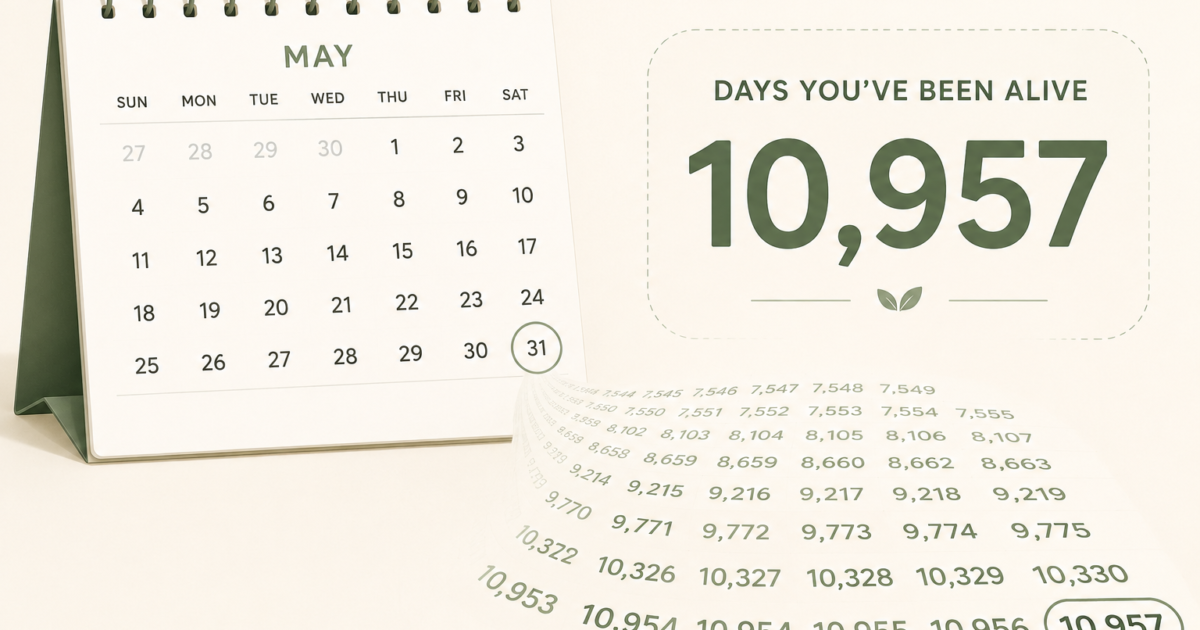
If you want to know how many days you’ve been alive, the honest answer is: it depends entirely on your exact date of birth and the date you’re counting to. Leap years, the specific calendar dates involved, and even how the count treats the current day all shift the final number — which is why there’s no single “days alive” figure for any given age. A 30-year-old born in a leap year has lived a different number of days than a 30-year-old born the year after one.
This guide explains exactly how that calculation works, why simple shortcuts like multiplying your age by 365 fall short, and how leap years, months, and other units factor in. For your own personalized, exact result, the Chronological Age Calculator does the date math for you — enter your date of birth and it returns your exact age, with advanced outputs covering total days, weeks, months, and hours.
Get Your Exact Number Right Now
Rather than estimating, the fastest way to know precisely how many days you’ve been alive is to use the Chronological Age Calculator. Enter your date of birth, and the tool calculates your exact age in years, months, and days, with a reference-date option if you want your age as of a past or future date instead of today. Enable advanced outputs to see the same result expressed as total months, total weeks, total days, and total hours — and a clinical years;months notation if you need that format for professional use. The calculator also supports comparison mode if you want to check exact ages for multiple birth dates side by side.
How Many Days Have I Been Alive?
Quick answer: To find your exact number of days alive, subtract your birth date from the date you want to calculate to. Because everyone is born on a different date, and because leap years add an extra day to some years and not others, there’s no single number that applies to everyone at a given age — the result has to be calculated from your specific birth date.
Entering your exact date of birth into the calculator above is the simplest way to get an individualized, accurate answer. Everything below explains the mechanics behind that number, so you understand what’s actually being calculated and why two people who are “the same age” in years can have lived a different number of days.
What Does “Days Alive” Mean?
“Days alive” sounds simple, but there are a couple of concepts worth separating clearly.
Calendar age is your age expressed in the familiar units — years, months, and days — based on calendar dates. It’s what you’d write on a form: “34 years, 2 months, 11 days.”
Elapsed time since birth is the same underlying span of time, just expressed as a single running total — total days, total hours, or total minutes since your birth date. Both describe the same length of time; they’re just different units for looking at it.
Most day-count calculations work from completed calendar days — the number of full calendar days between your birth date and the calculation date — rather than accounting for the exact time of day you were born. That’s an important distinction: unless a tool specifically asks for your birth time, it’s counting from midnight-to-midnight calendar dates, not the literal number of 24-hour periods since your specific birth moment. This is also why two different calculators can occasionally show results a day apart — it usually comes down to whether the current, not-yet-complete day is being counted or excluded.
How to Calculate How Many Days You Have Been Alive
Step 1: Enter your birth date
Start with your exact date of birth — month, day, and year. A birth year alone isn’t enough for an exact count.
Step 2: Select the calculation date
Decide whether you want your total as of today, or as of a specific past or future date.
Step 3: Account for leap years
Every leap year between your birth date and the calculation date adds one extra day (February 29) to the total. Skipping this step is the most common source of error in manual day counts.
Step 4: Calculate the number of calendar days
Subtract your birth date from the calculation date, counting every calendar day in between, including the leap-year adjustments from Step 3.
Step 5: Convert into weeks, months, hours, or minutes if desired
Once you have a total day count, converting it into other units is straightforward multiplication or division — covered in the sections below.
Doing this by hand gets complicated fast once multiple years and several leap years are involved, since you’re effectively counting through every intervening calendar date. That’s exactly the kind of repetitive, error-prone math a calculator handles instantly and reliably — the Chronological Age Calculator does this full calculation for you the moment you enter a birth date.
The Formula
At its core, the calculation is a date subtraction, not a multiplication:
Days alive = calculation date − date of birth
That’s meaningfully different from the shortcut some people reach for:
age in years × 365
The multiplication shortcut ignores leap years entirely, which means it under-counts the true total by roughly one day for every four years of life. For a precise result, you need an actual date-to-date subtraction that accounts for which specific years in that span were leap years — not an approximation based on a flat 365-day year.
Why Age × 365 Is Not Exact
It’s tempting to just multiply your age by 365 and call it a day (so to speak), but here’s why that shortcut falls short.
Take 30 years as an example:
30 × 365 = 10,950 days
But the actual number of days in 30 calendar years, accounting for leap years, works out closer to 10,957 days — a difference of about a week. That gap exists because roughly a quarter of the years in any multi-decade span are leap years, each contributing one extra day that the simple multiplication never accounts for.
The exact figure also depends on:
- Which specific years in your lifespan were leap years
- Your exact birth date (someone born January 1 vs. December 31 of the same year has lived a different number of days by any given calculation date)
- The specific calculation date you’re measuring to
- Whether the current, incomplete day is counted
In short: age × 365 gives you a rough ballpark, not your actual day count. A real date-difference calculation is the only way to get an exact number.
How Leap Years Affect How Many Days You Have Been Alive
A leap year adds one extra calendar day — February 29 — roughly every four years, which keeps the calendar year aligned with the actual time it takes Earth to orbit the sun (about 365.2425 days, not a flat 365).
Over a short span, that extra day barely registers. Over a lifetime, it adds up meaningfully: someone who has lived through 20 leap years has lived 20 more days than a flat 365-day-per-year calculation would suggest. That’s a big part of why exact date subtraction beats any simplified formula — it automatically accounts for every leap year that actually occurred during your specific lifespan, rather than assuming a fixed average. If you want to check whether a specific year was a leap year, or see the nearest leap years to any date, the site’s Leap Year Calculator handles that instantly.
Age in Days, Weeks, Months and Years (Approximate)
The table below gives approximate figures for common ages. These are not exact for any individual — your real numbers depend on your specific birth date and how many leap years fall within your lifespan.
| Age | Approximate Days | Approximate Weeks | Months |
|---|---|---|---|
| 1 year | ~365 | ~52 | 12 |
| 5 years | ~1,826 | ~261 | 60 |
| 10 years | ~3,653 | ~522 | 120 |
| 18 years | ~6,574 | ~939 | 216 |
| 21 years | ~7,670 | ~1,096 | 252 |
| 30 years | ~10,957 | ~1,565 | 360 |
| 40 years | ~14,610 | ~2,087 | 480 |
| 50 years | ~18,263 | ~2,609 | 600 |
| 60 years | ~21,915 | ~3,131 | 720 |
| 70 years | ~25,568 | ~3,652 | 840 |
| 80 years | ~29,220 | ~4,174 | 960 |
Months are exact (age in years × 12) since that unit doesn’t depend on leap years. Days and weeks are approximate averages and will differ slightly from any individual’s real total depending on their exact birth date.
How Many Days Have I Been Alive at Different Ages?
Using the table above as a reference point, here’s roughly what different common ages translate to in days — again, treat these as approximate starting points rather than your personal number.
- 18 years old: approximately 6,574 days
- 20 years old: approximately 7,305 days
- 21 years old: approximately 7,670 days
- 25 years old: approximately 9,131 days
- 30 years old: approximately 10,957 days
- 35 years old: approximately 12,784 days
- 40 years old: approximately 14,610 days
- 50 years old: approximately 18,263 days
- 60 years old: approximately 21,915 days
- 70 years old: approximately 25,568 days
- 80 years old: approximately 29,220 days
If you want your actual figure rather than an age-based approximation, entering your specific date of birth into the Chronological Age Calculator and switching on advanced outputs will give you the precise total.
How Old Am I If I Was Born in 1998?
If you were born in 1998, you’re either 27 or 28 years old during 2026, depending on whether your birthday has already happened this year. Birth year alone only narrows your age down to a two-year range — it can’t tell you the exact number, because someone born in January 1998 and someone born in December 1998 are at different points in their birthday cycle for most of any given calendar year.
Here’s how the level of detail you know affects what you can determine:
| Birth Date Information | What You Can Determine |
|---|---|
| 1998 only | Approximate age range (two possible ages) |
| Month + 1998 | A narrower range, but still not exact without the day |
| Full date of birth | Exact current age |
| Full date + target date | Exact age on any specific date, past or future |
For an exact answer rather than a range, enter your full date of birth into the Chronological Age Calculator, which also lets you check your exact age as of a future or past date if you need that for planning or documentation.
How Old Am I If I Was Born in 1997?
Someone born in 1997 is 28 or 29 years old during 2026, again depending on whether their 2026 birthday has passed. The same logic applies as above: 1997 alone establishes a range, not a single number, because the exact age flips on your specific birthday, not January 1st.
If you know the month you were born but not the exact day, you can narrow the range further, but you’ll still need the full date for a precise, single-number answer — which the age calculator can give you instantly.
How Old Are You If You Were Born in 1994?
If you were born in 1994, you’re 31 or 32 years old during 2026. The determining factor is always the same: has your birthday for the current year already occurred? Before it, you’re the younger of the two possible ages; after it, you’re the older one.
This is a common point of confusion for people trying to reverse-engineer an age from a birth year alone, especially in comments sections or casual conversation — the honest answer is always a two-year range unless the specific birth date is known.
How Old Is Someone Born in 1983?
Someone born in 1983 is 42 or 43 years old during 2026, depending on whether their birthday has occurred yet this year. As with the other birth years above, a precise single age requires the full date of birth, not just the year.
Addressing “67 Kid” Searches
Some searchers land on “67” age questions expecting a birth-year calculation — as in, someone born in 1967 would be turning 59 in 2026. But it’s worth noting that a large share of current “67 kid” searches are actually about an unrelated, viral internet meme: a video of a young boy responding “six-seven” at a basketball game, which spread widely online and spawned its own meme culture separate from any birth-year meaning. If that’s what brought you here, this guide won’t have the answer — but if you’re genuinely asking about someone born in 1967, the same rule applies as above: they’re 58 or 59 years old during 2026, depending on whether their 2026 birthday has passed, and an exact answer requires their full date of birth.
How Many Months Are in 18 Years?
18 years × 12 months = 216 months.
That conversion is exact, since a year always contains exactly 12 months regardless of leap years. It’s a different story once you convert 18 years into days or weeks, though — those units are affected by leap years, so 18 years works out to approximately 6,574 days and approximately 939 weeks, rather than a perfectly clean round number. If you need any of these conversions for a specific birth date rather than a flat 18-year span, the calculator’s advanced outputs handle total months, weeks, days, and hours together in one result.
How Many Hours, Minutes and Seconds Have I Been Alive?
Once you have a total day count, converting to smaller units is simple multiplication:
- 1 day = 24 hours
- 1 hour = 60 minutes
- 1 minute = 60 seconds
So a rough day-to-hour conversion just multiplies your day total by 24, and so on down the chain. One caveat worth being upfront about: these conversions are typically based on completed calendar days, not your literal time of birth. Unless a calculator specifically asks for and uses your birth time, an “hours alive” or “minutes alive” figure is really an hour/minute conversion of your day count — not a true second-by-second count from your actual birth moment. Treat second-level precision from a birth date alone as illustrative rather than exact, since true precision would require your recorded time of birth as well.
When Will I Reach 10,000 Days Alive?
Ten thousand days is a milestone plenty of people find genuinely interesting to calculate, since it doesn’t map neatly onto a round number of years.
10,000 ÷ 365.2425 ≈ 27.38 years
So the 10,000-day mark falls a little more than 27 years and 4 months after birth — but the exact calendar date depends entirely on your specific date of birth and how many leap years fall within that span. Other notable day milestones people often check include:
- 1,000 days (roughly 2.7 years)
- 5,000 days (roughly 13.7 years)
- 10,000 days (roughly 27.4 years)
- 15,000 days (roughly 41.1 years)
- 20,000 days (roughly 54.7 years)
- 25,000 days (roughly 68.4 years)
- 30,000 days (roughly 82.1 years)
If you want your exact 10,000-day date (or any other milestone), enter your birth date into the Chronological Age Calculator and use the reference-date option to test different target dates until you land on the milestone total you’re after.
Days Alive vs. Chronological Age
These two ideas describe the same underlying span of time in different formats.
Chronological age expresses your age in calendar units — years, months, and days — the format used on medical records, school forms, and legal documents. It’s the “34 years, 2 months, 11 days” style answer.
Days alive expresses that same span as one running total. Both are accurate; they’re just suited to different purposes. Chronological age is more useful for age-based eligibility, developmental comparisons, and standardized paperwork. A total day count is more useful for milestone tracking, curiosity, or simply getting a visceral sense of how much time has actually passed.
The Chronological Age Calculator gives you both formats from the same birth date entry — the standard years/months/days breakdown, plus the total-days and other elapsed-time outputs if you switch on advanced results.
Why People Look Up Their Exact Day Count
Curiosity is the most common reason, but it’s not the only one. A few practical situations where knowing your precise day count (rather than just your age in years) actually matters:
Milestone tracking. Reaching 10,000 days, 15,000 days, or any other round number is a popular personal marker — some people plan a small celebration or reflection around it, similar to a birthday but on a different cycle entirely.
Comparing time spans directly. “How many days have I been at this job” or “how many days since I quit smoking” are easier to compare against your total days alive when both are expressed in the same unit, rather than converting between years and days in your head.
Age-sensitive eligibility with day-level precision. Certain legal, medical, or competitive-eligibility contexts (like age-group sports cutoffs or developmental assessments) sometimes require an exact day count rather than a rounded age in years, particularly close to a cutoff date.
Simple perspective. A day count is a different, sometimes more vivid way to think about elapsed time than “I’m 34” — tens of thousands of days can land differently than three-digit-adjacent years.
Whatever the reason, the underlying math is the same: an exact date-to-date calculation from your birth date, not an estimate.
Conclusion
The exact number of days you’ve been alive depends entirely on your specific birth date, the date you’re measuring to, and how many leap years fall in between — there’s no universal number that applies to “everyone who is 30” or “everyone born in 1998.” A simple age-times-365 shortcut gets you in the right neighborhood but consistently under-counts by ignoring leap years, which is why an actual date-to-date calculation is the only way to get a truly accurate answer.
Whether you’re curious about your total day count, planning around a milestone like 10,000 days, or need an exact age in years, months, weeks, or hours, the Chronological Age Calculator handles the full calculation instantly from your date of birth — no manual counting or leap-year math required.
9. FAQ Section
How many days have I been alive? It depends on your exact date of birth and the date you’re calculating to — there’s no single number for a given age. Enter your birth date into an age calculator for a precise, individualized total that correctly accounts for leap years.
How do I calculate how many days I have been alive? Subtract your date of birth from the date you’re calculating to, counting every calendar day in between and including any leap-year days that fall within that span. This is more accurate than multiplying your age in years by 365.
How many days old am I? This is calculated the same way as “how many days have I been alive” — by finding the exact number of calendar days between your birth date and today, accounting for leap years along the way.
Does my exact birth date matter? Yes. Birth year alone only narrows your age to a range of two possible values, since it depends on whether your birthday has occurred yet this year. The full date — month, day, and year — is required for an exact day count.
Do leap years affect how many days I have been alive? Yes. Each leap year within your lifespan adds one extra day (February 29) to your true total, which a simple age × 365 calculation doesn’t account for. Over a full lifetime, this can add up to a couple of weeks’ difference.
How many days are in 18 years? Approximately 6,574 days, though the exact figure depends on how many leap years fall within that specific 18-year span, which varies based on the exact birth date.
How many months are in 18 years? Exactly 216 months (18 × 12). Unlike day or week conversions, the months figure is exact and unaffected by leap years, since every year contains exactly 12 months.
How old am I if I was born in 1998? You’re 27 or 28 years old during 2026, depending on whether your 2026 birthday has occurred yet. An exact single age requires your full date of birth.
How old am I if I was born in 1997? You’re 28 or 29 years old during 2026, depending on whether your 2026 birthday has passed. The birth year alone can’t tell you which one without knowing the specific date.
How old are you if you were born in 1994? You’re 31 or 32 years old during 2026, depending on your birthday status for the year. As with other birth-year questions, the exact answer needs a full date of birth.
How old is someone born in 1983? They’re 42 or 43 years old during 2026, depending on whether their 2026 birthday has already occurred.
How many hours have I been alive? Multiply your total days alive by 24. This is typically based on completed calendar days rather than your exact time of birth, so treat it as a close approximation unless your birth time is factored in specifically.
How many weeks have I been alive? Divide your total days alive by 7. As with days, this figure is exact once you know your precise day count, which itself depends on your full birth date and any leap years in your lifespan.
When will I reach 10,000 days alive? Roughly 27 years and 4 months after birth (10,000 ÷ 365.2425 ≈ 27.38 years), though your exact milestone date depends on your specific birth date. A calculator with a reference-date option can pinpoint the exact day.
What is the difference between chronological age and age in days? Chronological age expresses your age using calendar units (years, months, days), while age in days condenses that same span into a single running total. Both describe the same length of time — they’re just formatted differently for different uses.